Transcription Accuracy for Technical Jargon and Domain Terms
Domain terms fall outside training data, making them invisible to speech-to-text models.
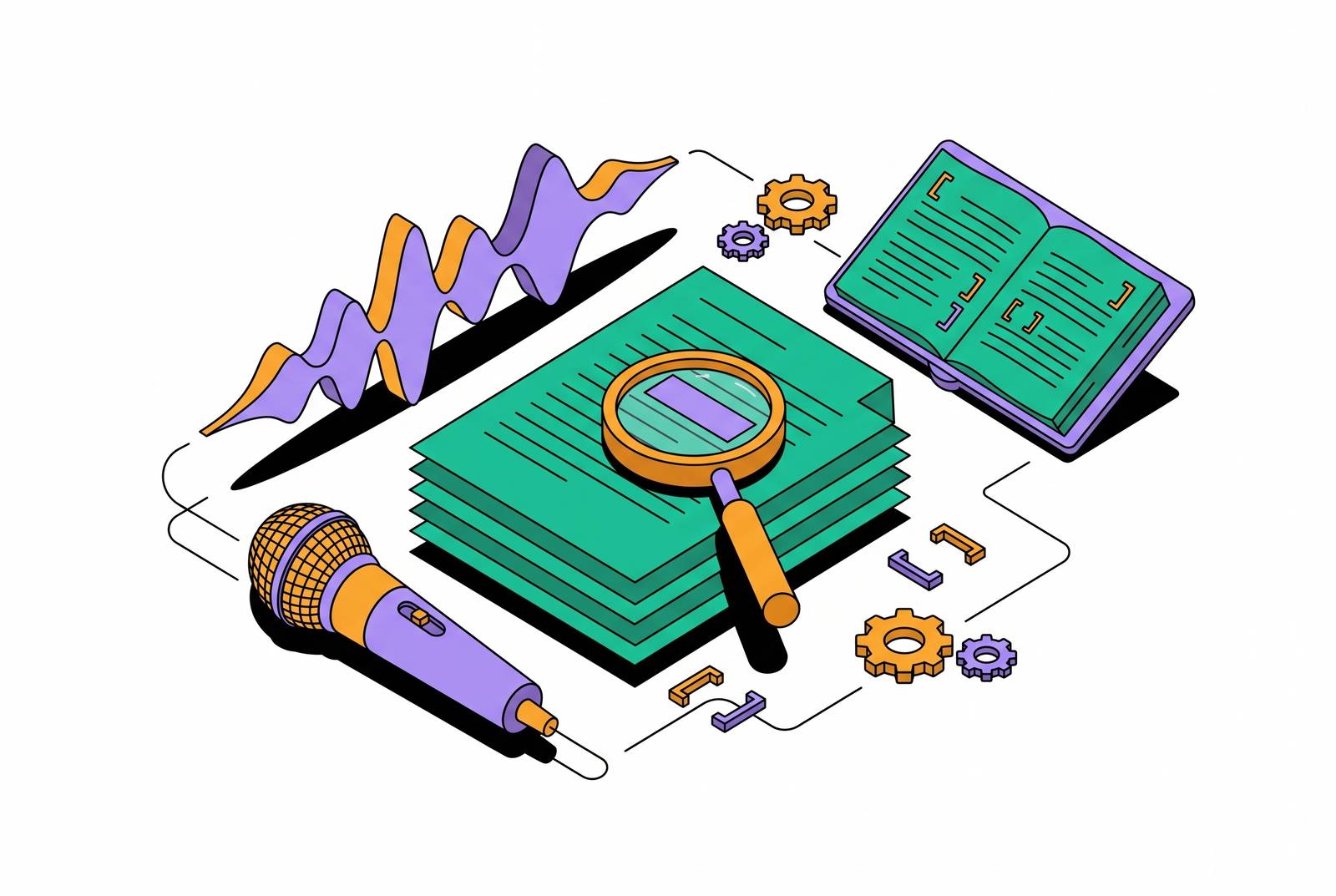
Why domain terms fall outside the training used for speech-to-text models
Speech-to-text systems run on transformer architectures trained across enormous audio datasets, refined through continual learning as more data comes in. Mechanically, the model listens to a waveform, matches patterns against what it's already seen, and outputs the most statistically likely sequence of words. That's the entire operation. The model predicts what got said. It does not reason about what got said, and that distinction explains most of what goes wrong later.
Prediction accuracy depends on how well a term is represented in the training distribution behind it. Common terms in law, medicine, and engineering appear often enough in training data to get represented decently. A company's internal product name, an acronym someone coined last sprint, a proprietary term that exists nowhere outside one team's Slack channel: none of that carries statistical weight anywhere in the model's training. It's an outlier by definition, and outliers get flattened toward whatever the model has seen more of.
That produces a specific and genuinely dangerous failure mode. When the model hits a word it doesn't recognize but which sounds like a word it does, it swaps in the familiar word with full confidence. The output reads fluently, so nobody catches it on a first pass. A garbled or blank transcription draws attention to itself. A wrong word delivered fluently doesn't, and that's the more expensive failure of the two.
Layer on the two-stage architecture most AI meeting tools run now: an ASR layer converts audio to raw text, then a large language model interprets that text to build summaries and action items. Errors at the ASR layer climb rather than stay put. A mangled product name in the raw transcript becomes a mangled product name in the summary, then a mangled product name in the action item pulled from that summary.
The fix has to happen before the model starts predicting, not after. That means feeding it custom vocabulary at inference time, or letting it accumulate exposure to a term across repeated use. No human editor patches this by proofreading the output afterward. The correction has to land at the input stage or the model configuration stage, because by the time words hit the page, the damage is already baked into whatever gets built on top of them.
What word error rate measures, and what it misses for technical meetings
Word error rate, the standard metric vendors quote, counts substitutions, deletions, and insertions and divides that sum by the total word count in a reference transcript. It can run past 100 percent if a transcript is bad enough. As a number, it's precise. As a measure of what matters in a technical meeting, it's close to useless.
WER treats every word as equally important. "The," "and," and "a" count exactly the same as "Kubernetes," "EBITDA," or a company's own product name. A transcript that nails every article and preposition while flattening every technical term into something else entirely can still post a low, respectable WER score. The metric rewards getting the connective tissue right and never penalizes losing the content the meeting was actually about. That's the whole problem with quoting a single WER figure as proof of accuracy: it measures the wrong 90 percent of the sentence.
AssemblyAI's 2026 benchmarks put WER at 4.35 to 6.24 percent across accented English, general speech, and webinar audio, translating to roughly 94 to 96 percent accuracy. Those are strong numbers on their own terms, and there's no reason to dismiss them. But they're measured against standard vocabulary corpora, not against domain-specific test sets built from legal depositions or engineering sprint reviews. The benchmark and the meeting are testing two different things, and only one of them resembles what actually happens on a Tuesday afternoon call.
Diarization, meaning who-said-what attribution, matters just as much as word accuracy for meeting use cases, and it represents a distinct axis of error that standard WER figures do not capture. An action item where the words transcribe correctly but land on the wrong speaker is a commitment with no owner. Vendor benchmarks do show WER spiking above 15 percent under "challenging conditions," but that category usually means background noise and heavy accents, not jargon specifically. Jargon gets buried inside a broader bucket where its own failure pattern disappears from the published numbers.
The only evaluation that means anything runs a candidate tool against actual recordings from actual meetings, using actual vocabulary. Benchmark numbers set a floor, nothing more. They say nothing about the ceiling a given team will hit, or the specific gap between advertised accuracy and what that team's own jargon does to the model. Test how the tool handles domain terms directly, how it attributes short interrupted turns, and how clean the action items look once pulled out of a genuinely technical discussion.
The four conditions that compound jargon errors in real meetings
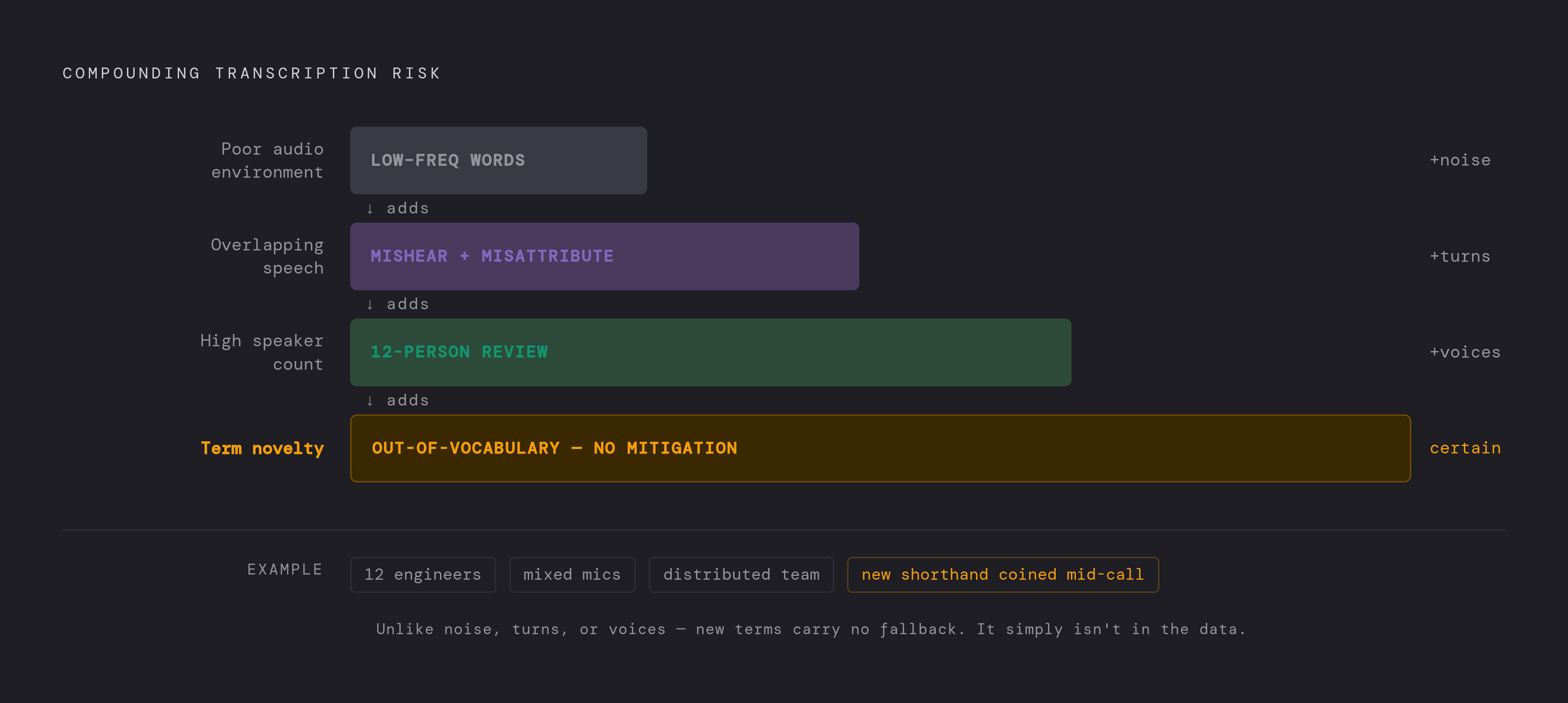
Audio environment sets the baseline. Poor microphones, someone dialing in from a car, a laptop mic sitting three feet from whoever's actually talking: background noise forces the model into lower-confidence territory precisely at the words it already knows least well. Noise doesn't degrade transcription evenly. It tends to hit hardest on terms the model is least confident about, which is where domain-specific jargon typically falls.
Overlapping speech compounds this. Fast turn-taking, interruptions, clipped utterances like "yeah," "wait, no," or "by Friday?" are exactly the patterns diarization systems tend to smear onto the wrong speaker. A technical term landing inside one of these short, interrupted turns is at risk twice over: the word itself might get flattened, and the attribution might land on the wrong person.
Speaker count adds a third layer. Accuracy degrades meaningfully as participant count grows beyond a small group. Large technical reviews, all-hands Q&A sessions, and panel-format product discussions carry the highest transcription risk simply because there are more voices, more overlaps, and more chances for the system to lose the thread.
Term novelty is its own category, and a particularly difficult one to address. Internal product names, version numbers, and acronyms coined last quarter postdate whatever data the model trained on. General industry jargon at least stands a chance of appearing somewhere in a large training corpus. Brand-new internal terminology is guaranteed to be out of vocabulary, full stop. There's no lottery ticket here; it simply isn't in the data.
A twelve-person engineering review, running on a mix of laptop mics and conference room speakers, where someone on a distributed team coins new shorthand mid-call, stacks all four conditions at once. A twelve-person engineering review, running on a mix of laptop mics and conference room speakers, where someone on a distributed team coins new shorthand mid-call, stacks all four at once. Sprint reviews, medical case discussions, legal depositions, financial model walkthroughs, and product roadmap sessions are exactly the meeting types where specialized vocabulary and high stakes collide, which makes them exactly the meeting types where transcription tools get tested hardest and fail most visibly.
The three technical mechanisms that improve domain term accuracy
Custom vocabularies are the most direct fix, and the first thing to check for in any tool. Teams supply a glossary of expected terms, and the system injects those as weighted hints at the point of inference, telling the model to prefer them when the audio is phonetically ambiguous. Google's Speech API implements this through a speechContexts field with an adjustable boost value, giving the model explicit signal to favor "React" or "TypeScript" over some phonetically similar common word it would otherwise default to. Trint is noted to support custom vocabularies specific to an industry or project along the same lines. This only helps for terms a team anticipates ahead of time, though. A brand-new acronym coined thirty seconds into the call gets none of that protection, no matter how thorough the glossary is.
The second mechanism sits a layer above the raw transcript. When a large language model processes ASR output, it can use surrounding context to catch or flag an implausible substitution. "The Kubernetes cluster" is recoverable even from a partially garbled version of "Kubernetes," because the LLM recognizes the phrase's semantic shape and fills the gap. This is the real architectural distinction between plain ASR output and what's marketed now as AI meeting intelligence: the LLM layer isn't just transcribing, it's interpreting, and interpretation gives it a shot at compensating for errors underneath it. Testing reveals the limit fast, though. If a term is entirely novel and lands close phonetically to a common word, context alone usually can't save it. An internal product name that happens to sound like "Acme" won't trigger a correction just because the LLM is context-aware.
Continual learning is the third mechanism, the slowest of the three, and arguably the most durable. The expectation with continual learning is that a platform's handling of an organization's specific terms improves as it processes more of that team's audio over time. That's the real argument for sticking with one platform instead of hopping between tools every few months: a system that's absorbed a team's vocabulary over dozens of calls holds an advantage that resets to zero the moment that team switches vendors. Vendors keep the adaptation mechanism opaque. The adaptation mechanism is typically opaque, leaving buyers unable to inspect it directly before signing a contract.
Where all three mechanisms fall short, teams fall back on the low-tech option: a glossary-driven search-and-replace pass run after transcription. It isn't elegant, and it won't catch anything novel, but for known recurring terms the model consistently mishears, it works, reliably and cheaply, which is more than can be said for waiting on continual learning to catch up.
How the two recording architectures handle domain terms differently
Two broad architectures dominate how meeting audio actually gets captured, and the choice between them affects domain-term accuracy before any correction mechanism even gets involved. Bot-based capture works by having an external participant join the video call, record from the platform's own audio stream, and process that recording on a cloud server. Audio quality here is a function of however the platform mixes every participant's input together. That averaging smooths out differences between individual microphones, but it also smooths out clarity, so a sharp speaker on a good mic gets pulled down toward the level of everyone else on the call.
Device-level capture works differently, and arguably better for this specific problem. The application pulls audio directly from the microphone and system audio on the user's own computer. This covers any platform where audio plays through that machine, Zoom, Google Meet, Microsoft Teams, WebEx, Slack huddles, without needing admin-level permissions on the meeting platform itself. Because it reads audio as the local machine receives it, quality swings with that one participant's setup rather than getting averaged against everyone else's. It can come out cleaner than a bot-mixed stream, or noisier, depending entirely on the hardware and the room, but at least the variance belongs to a single, identifiable source instead of a blended one.
Some tools available in 2026 now offer both, letting a team pick bot-based or bot-free desktop capture depending on the meeting. There's a consent dimension separate from accuracy, too. Bot-based recording is visible, since an extra participant shows up in the call. Device-level recording is silent to everyone else on the call, which raises a disclosure obligation that has nothing to do with which architecture captures cleaner audio and everything to do with telling people they're being recorded.
None of this changes which correction mechanisms apply downstream. Custom vocabulary support and language-model synthesis work the same way regardless of how the audio got captured. Architecture affects the quality of what goes in. It has no bearing on what happens to that audio once it's inside the transcription pipeline.
What transcription accuracy means for the outputs that matter (summaries, action items, and CRM entries)
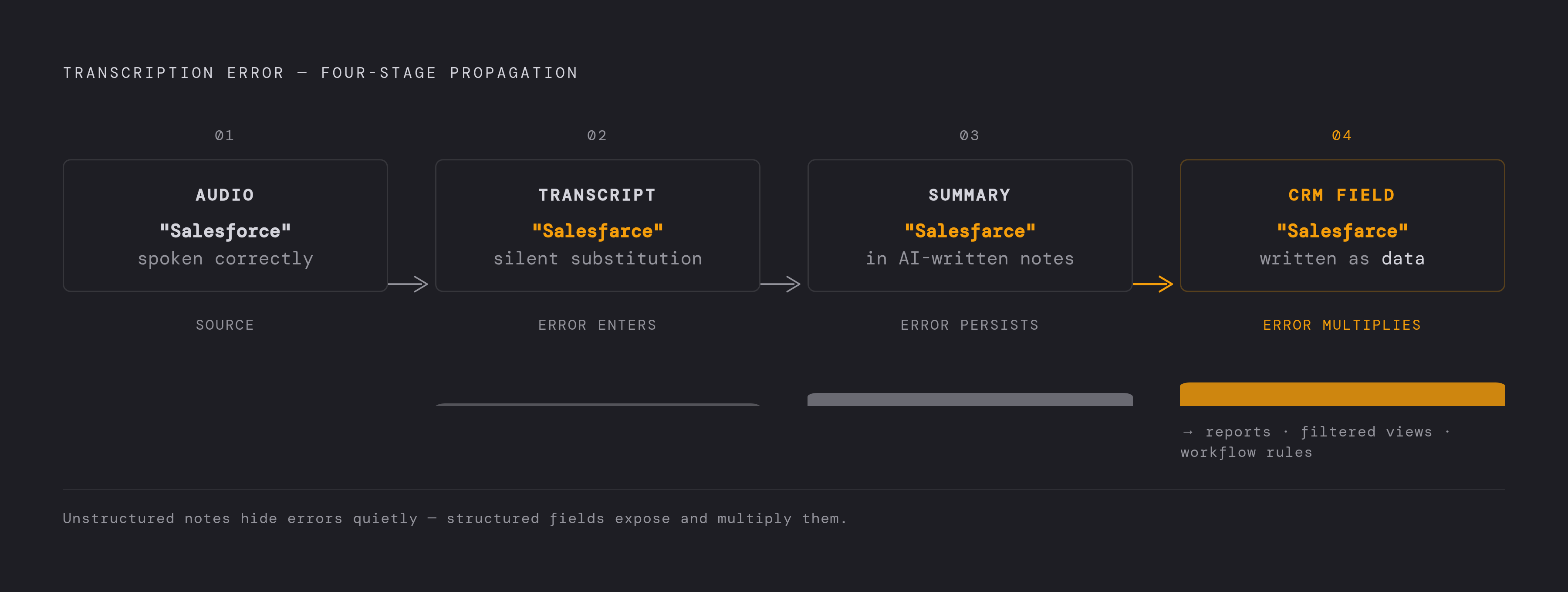
Summaries, action items, and search results are all downstream products of the transcript. Whatever mistake lives in the transcript gets inherited by everything built from it. A garbled product name doesn't stay a transcript-level curiosity. It becomes a wrong product name in a summary, then a wrong product name in a CRM field, at which point it stops looking like an error and starts looking like data.
Action items carry the highest stakes of any downstream output, because a usable one needs the commitment, the owner, and the deadline correct all at once. A single jargon error, or a diarization slip on a short turn as brief as "by Friday?" attributed to the wrong voice, can quietly reassign who owns a commitment without anyone noticing until the deadline's already passed.
CRM sync raises the stakes further. AI-to-CRM automation for meeting notes has matured considerably by 2026, which sounds like progress until you consider what it means for errors moving through the pipeline faster and with less friction. A garbled entry no longer sits in a notes field where a human might catch it on a second read. Once a note writes a wrong product name into a structured CRM field, that error starts propagating into reports, filtered views, and automated workflow rules built on top of that field. Unstructured notes hide errors quietly. Structured fields expose and multiply them.
The underlying failure mode directly: a confidently wrong transcript does more damage than no transcript. Once someone catches a meeting summary misattributing a commitment or flattening a technical decision into nonsense, trust collapses fast, and people revert to rewatching the original recording, which defeats the purpose of running transcription.
Sales and customer success teams feel this hardest. When a customer names a competing product or specifies an exact technical requirement mid-call, that term has to survive a four-stage journey intact: audio, transcript, summary, CRM field. A single homophone substitution at any one of those stages corrupts the competitive intelligence the whole conversation was supposed to capture. The real question for anyone evaluating a tool is what happens, specifically, to the name of a product, a competitor, and a customer's stated requirement by the time that information lands in a CRM record someone else will act on months later. It's what happens, specifically, to the name of a product, a competitor, and a customer's stated requirement by the time that information lands in a CRM record someone else will act on months later.
Evaluating a tool's real domain accuracy before committing
Run the candidate tool against a real recording from the most jargon-dense meeting type on the calendar. Not a vendor demo. Not a curated sample recording chosen because it happens to transcribe well. An actual meeting, with the actual acronyms a team uses every day.
From that test transcript, three things get counted directly. Tally how many times each proprietary term, internal product name, or key acronym comes through correctly versus getting swapped for something else. Find a moment where two people talk within a few seconds of each other and check whether diarization attributes each line to the right speaker. Then pull the action items the tool generates and check each one for the correct owner, the correct commitment, and enough technical context to be usable without rewatching the recording.
Ask directly whether the platform supports a custom glossary and how that glossary gets applied: instantly, at the point of inference, or gradually, through learned exposure over time. A tool that only improves through gradual learning offers no protection during a team's first month of use, and that gap is exactly when the most expensive errors tend to happen, before the model has had a chance to absorb anything.
Accuracy on standard English has largely become table stakes among the leading tools in 2026. Real differentiation for any given team lives specifically in domain term handling and the quality of what comes out the other end. Speed matters too: most tools complete transcription in one to three minutes per hour of audio, and for real-time or streaming use cases, check whether the tool trades accuracy for lower latency, and whether that trade actually makes sense for the meeting format in question.
Once domain accuracy clears the bar, integration depth becomes the next real test. Does the tool write into structured CRM fields, or only into a general activity notes section? A mapped field can be filtered and reported on later. An activity note just sits there, readable only if someone happens to go looking for it.
The tool landscape for domain-heavy transcription needs
The figures below come from Sonix's guide. They're vendor-reported numbers, and real-world domain accuracy for any specific team's vocabulary still needs testing using the method described above, no matter how good these look on paper.
Sonix reports accuracy up to 99 percent on clear recordings, supports more than 53 languages, and is built to handle technical jargon, complex dialogue, and multi-speaker recordings. It offers custom prompts for transcript-specific queries, along with sentiment analysis, topic detection, and entity recognition. On the compliance side, Sonix carries SOC 2 Type 2 certification and AES-256 encryption. Pricing runs $10 per hour pay-as-you-go, or $5 per hour with a subscription, and the platform reportedly transcribes a 10-minute file in under two minutes.
Trint reports accuracy in the 90 to 95 percent range, supports more than 40 languages, and includes summaries, translation, and a limited set of AI tools. Trint is also the clearest sourced example of a platform built explicitly around custom vocabularies tied to a specific industry or project, and that's the detail that should drive the decision for a domain-heavy team over the language count or the breadth of the analysis toolkit. It integrates with Adobe Premiere Pro and Google Drive, with pricing starting at $80 per month.
The two tools aren't really competing on the same axis, and treating the choice as a coin flip between comparable products misses the point. Sonix leans toward breadth: more languages, faster turnaround, a wider analysis toolkit bolted on. Trint leans toward precision on vocabulary a team defines up front. For a legal team, a clinical research group, or an engineering org drowning in internal acronyms, that narrower focus on custom vocabulary is worth more than Sonix's extra thirteen languages or its sentiment analysis feature. Raw accuracy percentage is the wrong number to anchor on when the failure mode that actually costs money is a handful of specific terms getting mangled every single call.
Neither vendor's numbers substitute for testing against a team's own recordings. Vendor benchmarks describe favorable conditions by design, and the only test that counts is what survives contact with an actual meeting, actual jargon, and the actual acoustics of whatever room or laptop mic the team is stuck using.