Disclosing AI Notetakers to Meeting Participants
Organizations must disclose AI notetakers to all meeting participants to use them responsibly.
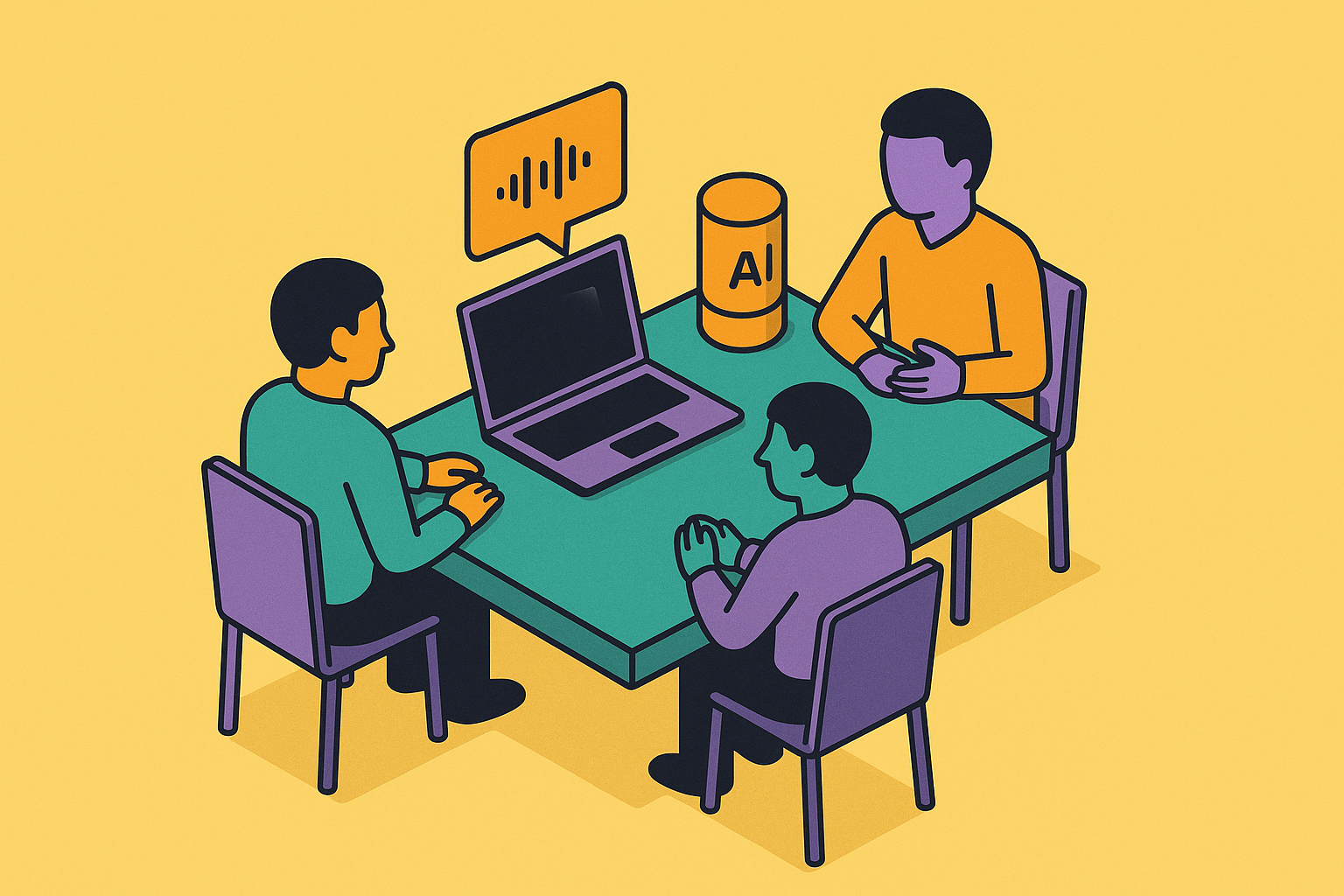
Disclosing an AI notetaker to the people in a meeting is the one behavior that makes these tools safe to use, and the one most organizations are getting wrong.
Why AI notetakers create a new disclosure obligation
A person taking notes by hand produces something partial, filtered through memory and judgment, and almost never seen outside the room where it was written. An AI notetaker produces something else entirely: a verbatim, speaker-attributed transcript that can be searched, copied, forwarded, and kept indefinitely, often by a vendor whose data practices nobody in the meeting ever read or agreed to. That difference in kind, not just in degree, is why disclosure now matters in a way it never did when the only record of a conversation lived in someone's notebook or memory.
Adoption of these tools has moved faster than the policies meant to govern them. Many organizations now have employees running different notetakers with different settings, different retention periods, and different ideas about who is allowed to see the output, all without a consistent standard anyone agreed to in advance. The gap widens between what these tools actually do, quietly and by default, and what the people being recorded understand is happening to their words. That gap matters because people make different choices about what to say depending on whether they think a conversation is being preserved word for word. A participant who doesn't know a permanent, attributable record is being created cannot decide whether to speak carefully, ask that something be off the record, or decline to attend. Consent requires that information, and without it, consent is not meaningfully possible.
The problem gets harder, not easier, in a meeting with people joining from different places. A single call can include someone in a two-party consent state, someone in a one-party consent state, and someone sitting in a country with an entirely different legal regime for recording and data protection. In that situation there is only one workable rule: the strictest standard that applies to anyone on the call applies to everyone on the call. None of this stems from a particular regulation or a particular lawsuit. It follows from what the tool itself does: it turns something that used to disappear into memory into something that persists, circulates, and can resurface later in contexts the original participants never agreed to.
The legal baseline: what consent law requires across US states and key international frameworks
In the United States, recording consent law is a patchwork that varies by state, and a full state-by-state breakdown is available through legal reference surveys for anyone who needs the specifics for a given jurisdiction. Some states require that only one party to a conversation consent to recording, while others require every party to agree, and a meeting that crosses state lines inherits the toughest rule among them.
Consent law is also only the first layer. Illinois' Biometric Information Privacy Act, known as BIPA, covers voiceprints directly and requires written consent before a voiceprint is collected, stored, or used. Plaintiffs have started arguing that speaker diarization, the process AI tools use to figure out who said what in a transcript, counts as collecting a biometric voiceprint under that law. That theory is being tested in several class actions filed in 2025 and 2026, and courts have not yet settled whether it holds up, but the exposure it creates is already real for any organization running these tools without written consent in place.
Healthcare adds a separate, non-negotiable obligation. Under HIPAA, a notetaker that transcribes a meeting touching protected health information becomes a business associate of the covered entity, full stop. Running that tool without a signed Business Associate Agreement is a HIPAA violation on its own, regardless of what any state consent law says.
Europe works from the opposite starting point. Under GDPR, employee consent generally isn't treated as a valid legal basis for recording at all, because an employee cannot freely consent to something requested by an employer who holds power over their job. The EU AI Act adds a further layer on top of that: AI systems used to evaluate, rank, or monitor people in recruitment or employee-monitoring contexts are classified as high-risk under Annex III, category 4, which brings obligations like risk assessments, human oversight, and bias testing. Those obligations attach specifically to systems performing evaluation or monitoring functions, not to every transcription tool by default, but any organization using notetaker output to assess employee performance needs to reckon with that classification directly.
No single rule covers every meeting. The only workable posture for an organization running meetings across states and countries is to default to the strictest standard in play rather than try to track which rule applies to which participant on which call.
Privilege and discovery in the courts
Professional ethics bodies have already set a standard that goes beyond what wiretap statutes require. New York is a one-party consent state, so a recording is legal there as long as one participant knows about it. A bar association ethics body has nonetheless held, in a formal ethics opinion, that secretly recording a conversation as a matter of routine practice shows enough lack of candor and trickery to be ethically impermissible, even where the underlying statute would allow it, with an exception only where disclosure would impair a generally accepted societal good.
That standard has since been extended directly to AI tools. NYC Bar Formal Opinion 2025-6, issued December 22, 2025, requires an attorney to get informed client consent before using any AI tool to record, transcribe, or summarize a client call, and to independently check the resulting work product for accuracy if there's any chance it will be kept or relied on later. The opinion also treats vendor data handling as a confidentiality concern under Rule 1.6: a lawyer has to think about what the notetaker's vendor does with the data, not just whether the client agreed to the recording. Formal Opinion 2026-2 then widens the circle of who that duty covers, applying the same reasoning to co-counsel, prospective clients, opposing counsel, witnesses, and employees or agents of the attorney, not just the client sitting across the table.
The courts, meanwhile, are still working out how AI tool use interacts with privilege and discovery, and the early rulings don't point in one direction. In February 2026, Judge Rakoff in the Southern District of New York ruled in United States v. Heppner that communications with an AI chatbot were not privileged, resting that decision on three separate grounds: the AI wasn't an attorney, the platform's own privacy policy undercut any expectation of confidentiality, and the purpose of the communication wasn't to get legal advice from counsel. In a different case the same month, Magistrate Judge Anthony Patti in the Eastern District of Michigan reached the opposite result in Warner v. Gilbarco, holding that a pro se litigant's queries to an AI tool and its responses were protected under the work-product doctrine.
Those two rulings aren't addressing the same facts, and neither maps cleanly onto an ordinary business meeting where a notetaker is simply transcribing a conversation. What they establish together is that outcomes turn on the specific vendor's data practices and the purpose of the communication, not on the simple fact that AI was involved somewhere in the process. AI-generated transcripts also change what becomes discoverable. A curated set of meeting minutes reflects a human decision about what mattered enough to record. An automated transcript captures nearly everything said, including remarks a speaker immediately walked back or corrected, so a verbatim board-meeting transcript can preserve speculative or offhand comments that a human note-taker would have simply left out.
The decisions that matter most here get made before any dispute exists: who knew the meeting was being recorded, how broadly the output gets used, and how long it gets kept. Those choices, made at the moment the recording happens, decide whether a transcript stays a useful internal record or turns into a liability someone has to explain in discovery years later.
Participant behavior under undisclosed recording and its costs
Undisclosed recording changes the conversation itself, before it ever becomes a legal problem. People speak more carefully, more candidly, and more loosely when they believe nothing permanent is being made of what they say, and people who find out later that a verbatim record existed the whole time tend to feel misled, even if nothing in the recording was ever used against them. The NYC Bar's reasoning in Opinion 2025-6 gets at exactly this: clients talk differently once they know a verbatim record is being created. Undisclosed recording changes the nature of what was said even if the client never learns a transcript exists.
A practitioner account captures what that costs in practice. After an AI notetaker joined a client call without any warning, it took two more weeks and a separate phone conversation before the client felt comfortable moving forward with the relationship. The client later said the unannounced bot made her wonder what else wasn't being disclosed, which is the real price of skipping notice: it doesn't just risk a legal complaint, it plants a specific doubt about everything else the other side hasn't mentioned.
HR and people teams run into a related failure mode that has already drawn public attention. Employees drop off a call while the AI assistant stays connected, keeps recording, and ends up capturing sidebar comments or gossip that never would have been written down by hand, and that transcript then gets distributed to the whole team as if it were a standard summary.
There's a second, quieter cost that appears even when disclosure happens and nobody feels deceived. Once people know everything is being captured, some stop paying close attention in the room, because the transcript will catch it later. That is what happens when a notetaker gets treated as a replacement for paying attention instead of a backup to it; the fix is the same disclosure habit paired with a deliberate choice to keep listening.
Why "bot-free" and "local recording" don't solve disclosure
Some notetaker tools run silently on the host's own device instead of joining the call as a visible bot, and they're sometimes marketed as the more ethical option because no other participant sees an obvious sign that recording is happening. That framing has the logic backward. From the perspective of everyone else on the call, a silent, local recording is worse than a visible bot, not better, because there is no signal at all that their voice is being captured.
A bot sitting in the participant list is an imperfect cue, but it is at least a cue. A background process running quietly on the host's laptop gives the other people on the call nothing to notice. "Bot-free" describes an architecture, not a consent process. Removing the visible bot doesn't remove the recording, the transcript, or whatever the vendor behind the tool does with that data afterward. It only removes the one visible signal that those things are occurring.
MyShingle Ethics Opinion 2026-2, issued July 11, 2026, makes this explicit for lawyers. Undisclosed recording counts as deceptive conduct under Rule 8.4 even in a one-party consent state, synthesizing the same reasoning the NYC Bar laid out in Formal Opinion 2025-6. The opinion is also direct that moving the transcription on-device doesn't satisfy the duties around consent, accuracy review, or retention. It only takes a third-party vendor out of the confidentiality picture, leaving every other obligation fully intact. Disclosure is something a person decides to do, not a side effect of which recording architecture a tool happens to use, and it has to happen deliberately no matter which kind of tool is running in the background.
What good disclosure looks like
Good disclosure is not a single announcement at the top of a call. It works as a layered habit, with notice given before the meeting, again at the start of the call, and in writing wherever the stakes are high enough to demand a record, and each layer does a job the others don't. Before an external meeting, such as a sales call, a client conversation, a vendor negotiation, or an interview, notice belongs in the calendar invite or the pre-meeting confirmation, naming the tool being used, describing what it captures, and giving anyone on the invite a clear way to object before they join. In legal or regulated work, MyShingle Ethics Opinion 2026-2 calls for addressing AI recording directly in the engagement agreement, spelling out consent, limitations, and what review of the output will look like, and that kind of disclosure built into a signed agreement holds up far better than a verbal mention tossed out at the start of a call. For recurring internal meetings, a standing policy set at the team or company level can serve as a baseline, but only if people actually acknowledge it somewhere, rather than it sitting unread in a page of the employee handbook nobody opens.
At the start of the call itself, the host should name the notetaker out loud, say what it will produce, whether that's a transcript, a summary, or a list of action items, confirm who will get access to that output afterward, and ask directly whether anyone on the call objects. A bot visible in the participant list offers a partial signal that something is being recorded, but the NYC Bar's guidance is clear that visibility alone isn't informed consent, only notice that recording might be taking place. On sales and customer-facing calls in particular, disclosure has to reach the external participants by name, because most US states require consent from every party on the call, and a bot that only shows up as visible to the internal team does nothing for the client on the other end.
For the highest-stakes conversations, attorney-client calls, HR conversations, board meetings, and investor meetings, consent belongs in writing. That can take the form of language in the engagement agreement, a pre-meeting email confirming the arrangement, or a consent checkbox built into the meeting platform itself. Written consent does more than tick a box: it leaves a record that the disclosure was made and understood, and if a dispute or regulatory inquiry ever surfaces, that record is what separates a defensible governance story from a genuine exposure. Who receives the disclosure matters just as much as whether it happens at all, since internal and external participants carry different consent requirements, and whichever jurisdiction on the call sets the strictest standard is the one the whole meeting has to meet.
Sources
- When AI Takes Notes: Protecting Privilege, Privacy, and Professional Obligations - Blank Rome LLP
- Cahill Discusses A.I. Note Takers in Corporate Meetings
- AI Privilege Waivers: SDNY Rules Against Privilege Protection for Consumer AI Outputs - Gibson Dunn
- Pause Before You Prompt: NY Court Finds AI-Generated Content Is Not Privileged
- Formal Opinion 2025-6: Ethical Issues Affecting Use of AI to Record, Transcribe, and Summarize Conversations with Clients
- Who’s Really in the Room? Hidden Risks of AI Note-Takers - Babst Calland - Attorneys at Law
- Is That Bot in Your Meeting Breaking the Law? - Mac Murray & Shuster LLP