Managing Employee Privacy Expectations for Internal Meeting Recording
Employers need policies covering both recording consent and biometric data collection separately.
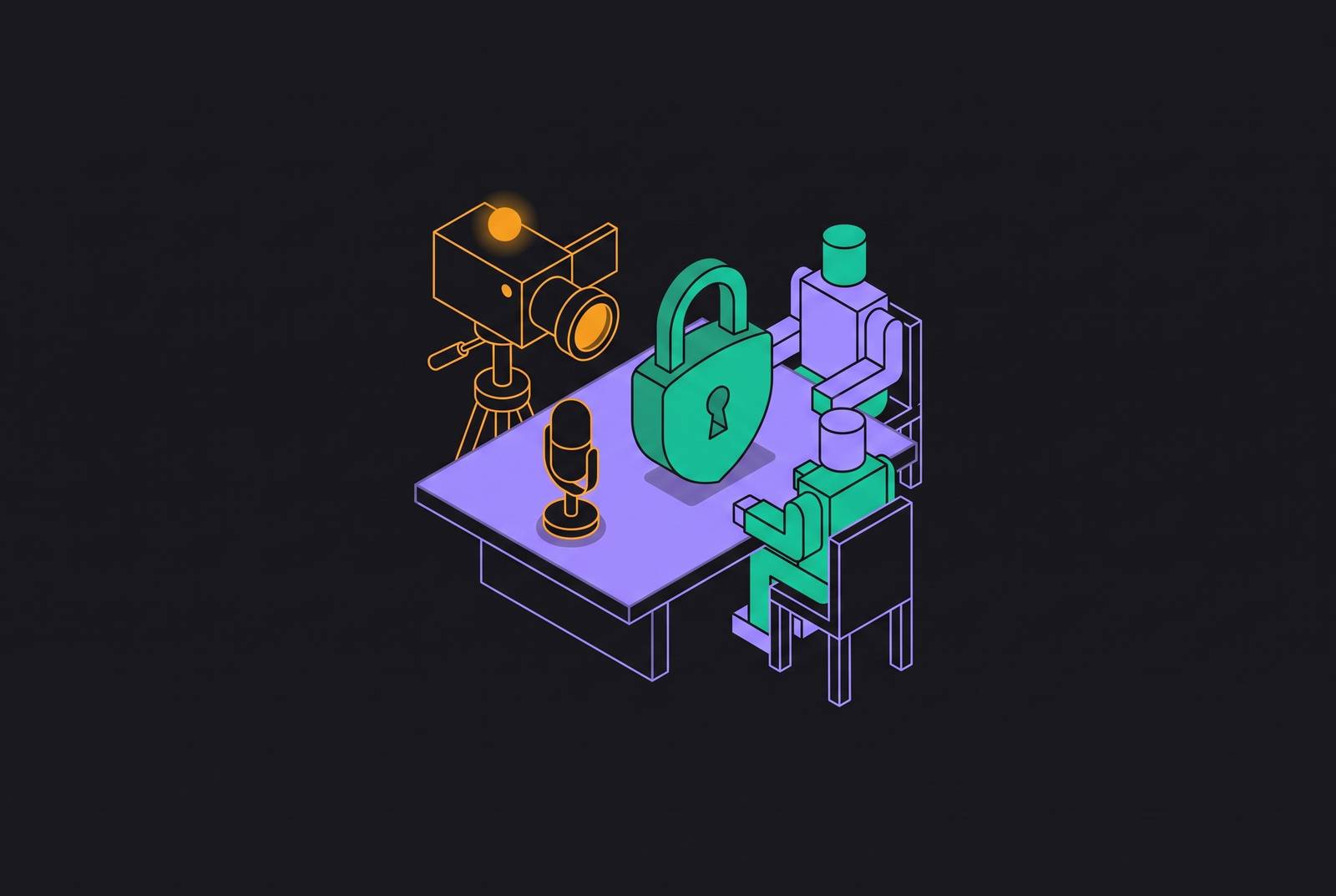
Internal meeting recording has moved from something a person chooses to do to something that simply happens, and most workplace policies have not caught up with that shift. The mechanism is unremarkable: an AI notetaker joins a call automatically through calendar integration, and recording starts before anyone in the room has made a conscious decision about it. No one clicks record. No one announces it. The bot simply appears in the participant list, already working.
The legal exposure behind that mundane sequence is significant. The wiretap statutes written for a person pressing a button on a tape recorder apply with equal force when a bot joins a call and starts capturing audio. How the recording happens does not change what the law requires of it. Littler's February 2026 analysis points out that in many workplaces, employees are already using AI notetakers on their own, so a ban is no longer a realistic option. The question organizations face is how to govern something that is already happening across most of the workforce.
AI tools add a layer of risk that human-operated recording never created. When a tool builds a voiceprint to tell speakers apart, it can trigger biometric privacy statutes, including Illinois' Biometric Information Privacy Act, entirely apart from whatever consent rules govern the recording itself. And once a meeting becomes a transcript and a summary, it becomes a document, one that carries the same legal hold obligations as an email chain in litigation. Every recording an organization is not actively managing is a record it may someday have to produce, defend, or explain in court.
The consent map that makes a single policy insufficient on its own
Most enterprise meetings are not governed by federal consent law, even though many organizations assume they are. The Electronic Communications Privacy Act, through its Wiretap Act provisions, says recording is fine when just one party to the conversation consents. That rule sets a floor, not a ceiling, and a long list of states build well above it. California, Connecticut, Delaware, Florida, Illinois, Maryland, Massachusetts, Montana, Nevada, New Hampshire, Oregon, Pennsylvania, and Washington are among the states that require all parties to a conversation to consent before it can be recorded. A company that tells itself "we follow federal law" and leaves it there is exposed in over a dozen states the moment a meeting includes someone sitting in one of them.
The penalties attached to these statutes are not uniform, and the variation matters. Illinois layers its eavesdropping statute on top of the Biometric Information Privacy Act, so a single AI tool can create felony exposure under one law and separate per-violation civil liability under the other, at the same time, for the same meeting. Gen. Laws ch. 272, § 99 as a felony carrying up to five years, while the disclosure or use of an unlawfully recorded conversation is a misdemeanor carrying up to two. Pennsylvania classifies the offense under 18 Pa.C.S. § 5703 as a third-degree felony with exposure up to seven years. New Hampshire's RSA 570-A:2 makes it a Class B felony, also carrying up to seven years. No employer operating across state lines can write one sentence of policy and expect it to clear all four of those statutes at once.
The legal questions do not stop at consent thresholds. Courts are still working through whether an AI bot joining a call counts as a party to the conversation, or whether it functions instead as an unauthorized third-party interceptor. In Ambriz v. In one case, a federal court declined to dismiss claims alleging that a vendor's AI acted as exactly that kind of outside party, capable of using intercepted call data for its own purposes. The court applied what amounts to a capability test, finding it plausible at the pleading stage that the AI's capacity to use the data independently made it a third party rather than a mere recording instrument. That ruling sits alongside a cluster of active cases. Four lawsuits were filed between August and September 2025 alone: Brewer v. Cal., still active as of 2026 with a motion to dismiss granted in part in August 2026; Galanter v. Cresta, brought under California's wiretapping statute in June 2025; and Lisota v. Heartland Dental, a federal wiretap claim filed in July 2025. This is litigation already in motion, a real risk already playing out in court.
Labor law pulls from the opposite direction at the same time. Under the Stericycle standard set by the NLRB in 372 NLRB No. 113 (2023), a blanket employer ban on all workplace recording is presumptively unlawful once the General Counsel shows it has a reasonable tendency to chill employees' Section 7 rights, including the right to record in order to document suspected labor violations or organizing activity. GC Memorandum 25-07, issued in June 2025, sharpens that constraint further: secretly recording a collective-bargaining session is a per se unfair labor practice, regardless of what the relevant state's consent law would otherwise allow. A workable policy has to satisfy both directions of pressure at once. It needs enough structure to require consent and disclosure for employer-initiated recording, and enough restraint to avoid prohibiting the recording activity that labor law protects.
AI tools expand the consent surface beyond recording
AI meeting tools introduce legal obligations that have nothing to do with recording consent. Deploying one of these tools creates at least two distinct compliance tracks: consent to be recorded, and consent to have biometric data collected. An organization that has only solved the first problem has not solved the second, and the two are evaluated under entirely separate bodies of law.
The biometric track centers on how these tools work. When a tool builds a voiceprint to tell one speaker from another across a transcript, it is generating biometric information as defined under several state statutes, regardless of how the vendor's marketing describes the feature. RecordingLaw's employee data privacy guide identifies Illinois' BIPA as the most consequential of these laws because it gives individuals a private right of action, with statutory damages running from $1,000 to $5,000 per violation. BIPA also requires written notice of what biometric data is being collected, a written release obtained before collection begins, and a published schedule for retaining and ultimately destroying that data. Illinois is a particularly sharp example of the double exposure this creates: its eavesdropping statute and BIPA apply independently of each other, so a tool that records a meeting without all-party consent and separately collects voiceprints without a written release can trigger liability under both laws for the same five minutes of audio. Colorado and Texas have each enacted biometric consent requirements of their own, and RecordingLaw describes biometric privacy as one of the fastest-moving areas of employee data law, with more states building out similar frameworks. A transcript that labels speakers by name, tied to voice pattern recognition, can itself be a form of biometric collection, independent of whatever consent was or wasn't obtained for the recording underneath it.
The third track is data governance under comprehensive privacy law, and it applies the moment personal data about an employee is processed. Under GDPR, a meeting recording becomes personal data as soon as an identifiable person speaks, appears on screen, or is named in the resulting transcript, and that obligation applies to any organization processing data tied to EU residents no matter where the company itself is headquartered. UK residents fall under a parallel UK GDPR regime. Spinach AI's August 2026 guide on enterprise meeting recording consent policy notes that explicit consent is often the weakest legal basis available for workplace recording under GDPR, because regulators doubt that an employee can genuinely refuse a recording request from their employer without professional consequence. A documented legitimate-interests basis, built on an actual balancing test, tends to hold up better than a consent checkbox that nobody felt free to decline.
International law adds further variation on top of that. Germany treats recording without consent as a criminal offense under section 201 of the German Criminal Code. Another country's data protection law requires clear, informed, and voluntary consent before personal data is collected, with explicit consent required when the data is sensitive. Another jurisdiction's data protection law requires consent as well, though that consent can be express or deemed depending on the circumstances. Reed Smith's analysis lays out what a compliant Notice at Collection has to state: what information is being captured, the purpose it will be used for (transcription, analysis, or AI model training, for instance), who will have access to it, and how long it will be kept. CalChamber's September 2026 guidance adds a practical warning that many AI notetaker tools store audio on third-party servers and may use that audio to train AI models. Employers need to review a vendor's data processing and privacy terms before deployment, particularly for meetings that touch sensitive employee information.
None of this is satisfied by the bot simply showing up visibly in the call. No jurisdiction treats a recording bot's presence in the participant list as legally sufficient notice or consent on its own. Consent under U.S. state wiretapping law and under GDPR requires informed agreement: a participant has to actually understand what is being recorded, how it will be used, who can access it, and how long it will be kept. Visibility gives people the chance to object, pause the meeting, or leave before anything sensitive is said. Covert recording removes that opportunity, and regulators and courts treat covert capture far more harshly than disclosed capture.
What a defensible internal recording policy must contain
A written policy delivered through an employee handbook and reinforced through training is the standard regulators and employment counsel expect to see. What goes inside that policy must cover at least seven specific areas to hold up across the jurisdictional map described above.
The policy should state its purpose and scope clearly: which meetings are covered, which roles are authorized to initiate a recording, and which platforms or tools fall under its rules. It should spell out permitted and prohibited activity, with one rule that carries no exceptions across any jurisdiction: covert recording is prohibited in all circumstances. It needs to describe how consent is obtained, whether that is verbal notice at the start of a meeting, specific language built into the calendar invite, or implied consent by joining a meeting where recording has already been disclosed, and it should specify which tier of consent applies to which type of meeting. It must lay out what happens when a participant objects, including a clear path to pause or remove the recording tool, because the absence of that path is where organizations lose employee trust fastest, independent of whatever legal risk is also sitting underneath it. It should define access and sharing rules: who can retrieve a recording, under what conditions, and whether participants can access their own meeting's recording by default or only on request. It needs retention periods set by data type, since video, transcript, and summary can reasonably carry different timelines, a 90-day retention window for video paired with a one-year window for transcripts is a legitimate and common configuration. And it should carve out exceptions for industries under heavier regulatory oversight, including legal, healthcare, and financial services, as well as for collective-bargaining sessions, which require the specific treatment GC Memorandum 25-07 demands.
Littler's February 2026 analysis adds a point that moves this from paper to practice: employers should configure their tools to limit use by jurisdiction and disable the features that carry the most risk, so the policy maps onto the tool's actual settings instead of existing only as a document nobody checks against reality. That can mean disabling automatic bot join for meetings with participants located in all-party consent states unless advance consent has already been confirmed, and disabling voiceprint-based speaker identification in states with active biometric statutes unless a written release is on file. Vendor contracts belong in this picture too. Reed Smith recommends that any third-party AI vendor be bound by a written data-protection agreement that explicitly prohibits using meeting data for unauthorized purposes, including training the vendor's own AI models on a company's internal conversations.
The policy also has to protect what it cannot restrict. A blanket prohibition on all employee recording is presumptively unlawful under the Stericycle standard, so the policy needs to govern employer-initiated recording and employer-deployed tools without implying that employees themselves are barred from recording to document a labor violation or a safety concern. For organizations with teams outside the United States, country-specific language is not an optional courtesy added for polish. Germany, China, Singapore, and EU member states each impose distinct consent and notice requirements, and a policy silent on those differences is a policy that only covers part of the workforce it claims to govern. None of this works if it lives only in a handbook nobody reads before a meeting starts; the actual mechanics of disclosure are what matter.
Tiered consent and disclosure mechanisms that employees encounter
A policy's consent requirements only mean something if the disclosure an employee actually sees matches the risk level of the meeting they are walking into. That requires more than one mechanism, because no single disclosure point reaches every participant at the moment they need it.
Advance written notice is the first layer, and it is the only one of the three that reaches a participant before they have joined the meeting. A standard line in the calendar invitation, stating that the session will be recorded and transcribed by an automated tool, gives someone the chance to object, ask a question, or decline to attend before the conversation starts. That cannot be the only mechanism, though, because calendar invites get forwarded, meetings get joined from links shared outside the original invite, and not everyone reads an invite closely before clicking in.
An active consent prompt at the start of the meeting itself closes part of that gap. This is the verbal or on-screen notice that recording has begun, delivered in the moment rather than in advance, so that someone who missed the calendar language still gets a clear signal before they start speaking. Paired with the advance notice, it creates two separate points at which a participant learns what is happening to the conversation they are about to have, rather than discovering it after the fact in a transcript they never agreed to generate.
The third layer is the governance work described in the previous sections translated into something an employee can actually see: a published retention schedule, a stated access policy, and a route to object or request removal that is referenced at the point of disclosure rather than buried in a handbook. Together, these three mechanisms do not substitute for one another. Advance notice sets expectations before the meeting begins, the active prompt confirms those expectations at the moment recording starts, and clear governance terms give employees somewhere to turn when they want to understand, or contest, what happens to the recording after the call ends. A policy that gets the legal architecture right but delivers it through only one of these channels still leaves employees guessing, and consent law, in every jurisdiction surveyed here, was written to prevent that guessing.