Automatic Action Item Detection and Attribution in AI Notes
The four-stage pipeline that turns meeting speech into attributed tasks, and where it fails most.
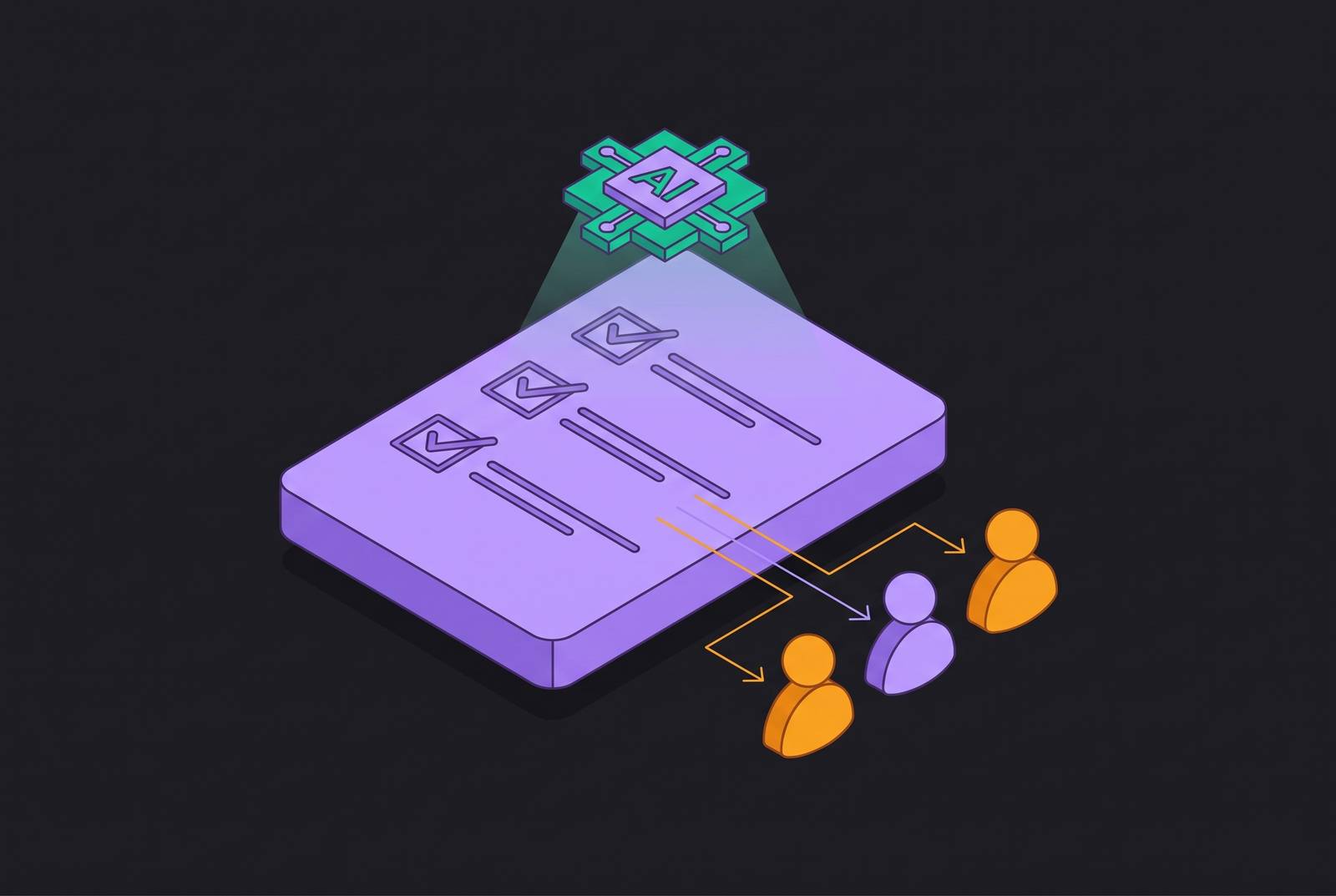
A meeting can end with clear agreement on next steps and still produce nothing. The task discussed out loud has to travel somewhere else to survive, and that transfer is where most commitments quietly die. Automatic action item detection and attribution exists to fix that handoff, and understanding how it works, stage by stage, explains why it sometimes gets the follow-through right and sometimes gets it badly wrong.
Why action item completion fails
A commitment made in conversation and a task recorded in a system are two different things, and the gap between them is a deliberate step that someone has to take by hand. The task needs to land in a CRM, a project tracker, or a to-do list, and moving it there takes a conscious action that, under the weight of back-to-back meetings, gets skipped more often than not. Ownership compounds the problem. A line like "follow up on the procurement timeline" carries an implied owner in the room, but whether that responsibility belongs to the account executive, the sales engineer, or the customer success manager depends on context that rarely survives into the written notes. Deadlines fare no better: when a due date gets mentioned at all, it tends to arrive as "before the next call" or "by end of day Friday," phrasing too loose for any tracking system to act on without a human translating it into a real date. None of this points to laziness. It points to a structural mismatch between how commitments get made (spoken, contextual, informal) and how work gets tracked (written, explicit, field-based), and closing that mismatch is the actual job of the technology this piece is about.
The four-stage pipeline that turns speech into attributed commitments
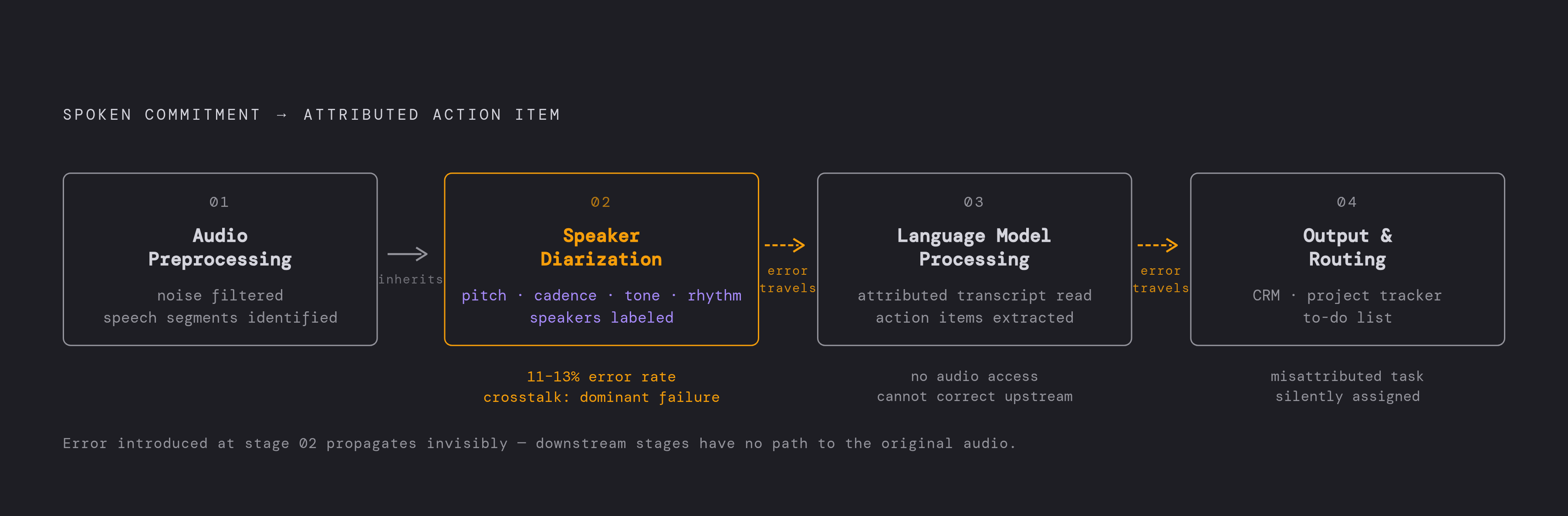
Action item detection is the final stage of a four-stage pipeline, and a mistake made early moves forward through every stage that follows it. The first stage is audio preprocessing, where background noise gets filtered out and the system identifies which stretches of the recording contain speech. This is where the recording setup first starts to matter: a bot connected directly to the meeting platform hears something different from a laptop microphone sitting in the middle of a conference table. The next stage, speaker diarization, takes each voice and converts it into a speaker embedding, a numerical fingerprint built from pitch, cadence, tone, and rhythm, then clusters similar embeddings together and labels them as distinct speakers. This is the stage that decides who said what, correctly or not. Only after these earlier stages finish does a language model enter the picture. In the final stage, it reads the full, attributed transcript and generates the summary, pulls out the action items, and identifies the decisions that were made. The language model works entirely from the transcript it receives, so an error introduced early in the pipeline reaches it with no way to be caught or corrected. The language model has no access to the original audio and no way to double-check a speaker label or recover a word that got lost upstream. It works entirely from the transcript it's handed, so a diarization error or a dropped word becomes permanent by the time summarization begins. The next two sections take up the two stages most responsible for that kind of permanent damage.
Speaker diarization as the pipeline's most consequential weak point
Diarization is where most attribution errors originate, and the conditions that cause those errors are common rather than rare. They're the default texture of how people actually talk in meetings. Research from Lanzendorfer and Grotschla in 2025 puts state-of-the-art diarization error rates at 11 to 13%, with crosstalk as the dominant cause, since accuracy drops sharply whenever two people speak over each other. Real meetings are full of exactly that. Interruptions, overlapping agreement, people finishing each other's sentences: these aren't disruptions to normal conversation, they are normal conversation, and diarization systems have to work through all of it.
The percentage understates what actually happens when the system gets it wrong. A single diarization error assigns a real commitment to the wrong person, and that mistake doesn't stay contained to one line of the transcript. It carries forward into the action item, into the summary, and into whatever CRM record or task ticket the tool generates afterward. Recording setup changes how often this happens. A bot with a direct connection into a Zoom or Teams call receives a cleaner audio signal than a laptop microphone picking up a shared room, because the input quality differs even when the diarization model underneath is identical in both cases. The input quality, not the model, is what shifts. Far-field audio, a single microphone trying to capture an entire in-person meeting, is the hardest condition of all, and the CHiME-8 DASR Challenge in 2024 confirmed that meeting environments remain one of the least solved problems in speech recognition generally. None of this argues against using these tools. It explains why attribution sometimes comes back wrong, and it points toward the one variable a team can control before the meeting starts: how the audio gets captured.
How tools compensate for diarization limits with hybrid attribution
Diarization by itself cannot close the attribution gap that crosstalk and far-field audio create, so the more capable tools stack additional signals on top of the acoustic analysis rather than relying on it alone. Platform metadata is the strongest of these signals. When a bot joins a Zoom or Teams call directly, it can read the participant list and match audio segments to confirmed identities, a more dependable anchor than voice characteristics alone. Some tools also build a stored voiceprint for participants who show up repeatedly, which cuts down on cold-start errors for people the system has already heard before. Calendar data provides a third layer of correction: if the audio signal is ambiguous but the calendar shows only two attendees on the call, the system can constrain the possible speakers to those two people, narrowing the space for error considerably. Language models contribute a fourth kind of signal, applied retroactively rather than in real time. If a speaker later in the transcript says something like "Hey Sarah, can you handle the design review," the model can use that explicit name reference to go back and relabel earlier utterances from the same voice, recovering context the audio signal never contained on its own.
Stacked together, platform metadata first, voice enrollment second, calendar data as a fallback, this hybrid approach performs more reliably than diarization running on its own. In-person sessions captured on a single microphone, with no platform metadata to lean on, are structurally harder to attribute correctly than video calls where a bot has direct access to the participant list, so the format a team chooses for a given meeting has real consequences for how trustworthy the resulting attribution will be.
How action item detection works once attribution is resolved
Certain phrases function as reliable markers: "we should," "let's," "can you," and similar constructions flag likely action item candidates, and modern NLP catches these consistently. The real difficulty is separating a soft suggestion from a firm commitment when the surface wording looks almost the same. "We should probably think about pricing" and "I'll send you the revised pricing by Thursday" can use similar verbs and similar structure, but only one of them is an actual commitment with an owner and a deadline attached.
A properly formed action item needs three components: the task itself, the person responsible for it, and the date it's due. When the transcript is missing one of those three, the correct behavior is to flag the item as incomplete rather than have the model guess at the missing piece. Flagging the gap instead of guessing keeps a false commitment from entering the record as though it were settled. A meeting that ended in genuine ambiguity, where the group never quite settled on an owner or a date, produces a worse outcome from a summary that states a confident, specific commitment than from a summary that honestly flags the gap. Confident language creates a false sense that something was settled when it wasn't, and the safer instinct is to treat any generated action item list as a draft that still needs a human to confirm it, not a finished record. One more variable shapes how well this stage performs: heavy jargon, product names, and acronyms that trip up the transcription stage will trip up extraction just as easily, so feeding a tool a domain-specific vocabulary ahead of time reduces errors at both points in the pipeline. Getting to this point, a transcript that's accurately attributed and cleanly parsed into distinct, well-formed action items, is genuinely difficult engineering. It's also where most teams stop paying attention, treating a clean summary as the finish line rather than the midpoint.
Action items fail without routing to where work is tracked
An action item that's correctly identified, correctly attributed, and sitting in a meeting notes app is invisible to every system that would actually remind someone to do it or surface it before the next relevant conversation. This is the same structural failure described at the start of this piece, just relocated. The same structural failure that made manual notes unreliable, action items living separately from where work is tracked, reappears if output isn't routed downstream. Ownership diffuses the same way it always has: when a task has no clear home and no clear owner watching a dashboard, nobody acts on it, and that dynamic doesn't care whether the list came from a human note-taker or a language model.
CRM integration in practice is where the gap between tools appears most clearly. Many attach meeting notes to a contact record as a logged activity rather than writing into structured fields, and mismatched attendee emails frequently generate duplicate contact records instead of updating the right one, so the CRM technically has a record of the meeting but nothing a sales manager can actually filter, report on, or trigger a reminder from. For someone in a high-volume role, a mid-market sales manager sitting in numerous calls a day, this stops being a matter of convenience. Same-day CRM sync and accurate attribution decide whether a missed follow-up on a prospect call turns into a missed deal.
The routing step across different tools and integrations
Tool quality in 2026 is separating less on how good the recap is and more on how cleanly that recap turns into a task inside the systems a team already runs on. A tool that creates the correct task, in the correct project, assigned to the correct person, with context attached, changes what the week actually looks like for that team. Different tools solve this differently. Fireflies can push action items and meeting summaries into Salesforce and HubSpot, though it does not natively populate structured CRM fields, which makes it a fit for teams whose main need is a CRM update paired with a follow-up workflow rather than deep field-level automation. Meeting notes tools increasingly build into broader platforms that also cover scheduling, coaching, call scoring, and optional revenue intelligence, alongside CRM sync. Some meeting notes tools offer integrations across HubSpot, Attio, Notion, Slack, Affinity, and Zapier, suiting teams that route work through several different systems. Some tools go further into automatic task creation, generating tasks and tickets after every meeting, sending candidate notes, transcripts, and scorecards into recruiting platforms like Greenhouse, Lever, and Ashby, and pushing summaries and action items directly into team communication channels.
The question that cuts through all of these feature lists is a simple one: does a given integration write into structured fields, or does it only log an activity? That answer shows whether the tool is actually tracking work going forward or just filing away a record of a conversation that already happened.
Meeting data as organizational memory through searchable action items
Reliable capture and routing compound over time into something larger than any single meeting's output. A searchable history of everything a team has committed to, decided, and agreed on becomes a different category of asset than any one summary ever could be on its own. Enterprise AI systems already have access to emails, documents, and support tickets, but the conversations where decisions actually get made are still locked away in isolated recordings and scattered personal notes. Those conversations hold the reasoning behind why one approach got chosen over another, what a customer actually said in their own words, and which risks got flagged before they turned into real problems.
Cross-meeting search, the ability to query an entire meeting history at once rather than one transcript at a time, is what turns an AI note-taker from a tool that simply cuts down on writing into something closer to an organization's institutional memory. A new hire trying to understand what got agreed about a product direction months earlier can query that history directly and get an answer with a citation attached, instead of piecing it together from scattered Slack threads. The Model Context Protocol is emerging as the infrastructure layer that extends this memory beyond the note-taking application itself, making it accessible to other AI agents across a company's tools. A coding agent could pull requirements directly from customer calls, and a sales agent could update CRM records from discovery conversations, both working from the full context of what a team actually discussed rather than a secondhand summary of it.
What attribution accuracy requires from teams
None of this pipeline runs on autopilot in any meaningful sense. Every stage described here depends on choices a team makes before, during, and after the meeting itself. Recording setup is the earliest and most consequential of these: connecting a bot directly to the meeting platform gives diarization and downstream extraction a cleaner signal to work with than a laptop microphone in a shared room, and that choice gets made before a single word is spoken. Feeding a tool custom vocabulary, product names, acronyms, the specific jargon a team uses daily, reduces errors at both the transcription stage and the extraction stage that follows it. Treating a generated action item list as a draft rather than a finished record means someone still checks that every item has an owner and a date, and flags the ones that don't rather than letting a confident-sounding summary paper over a meeting that actually ended without clear resolution. Choosing a tool based on whether its integrations write to structured fields, not just whether it produces a polished recap, decides whether the output actually gets tracked or simply gets filed away. The technology has gotten genuinely good at listening. What it still needs from the people running it is the discipline to verify, to set up recording conditions that give the system its best chance, and to route what gets extracted into places where the work will actually get done.