Handling Participant Objections to AI Meeting Recorders
Three objections to AI recorders mask deeper fears about surprise, data, and control.
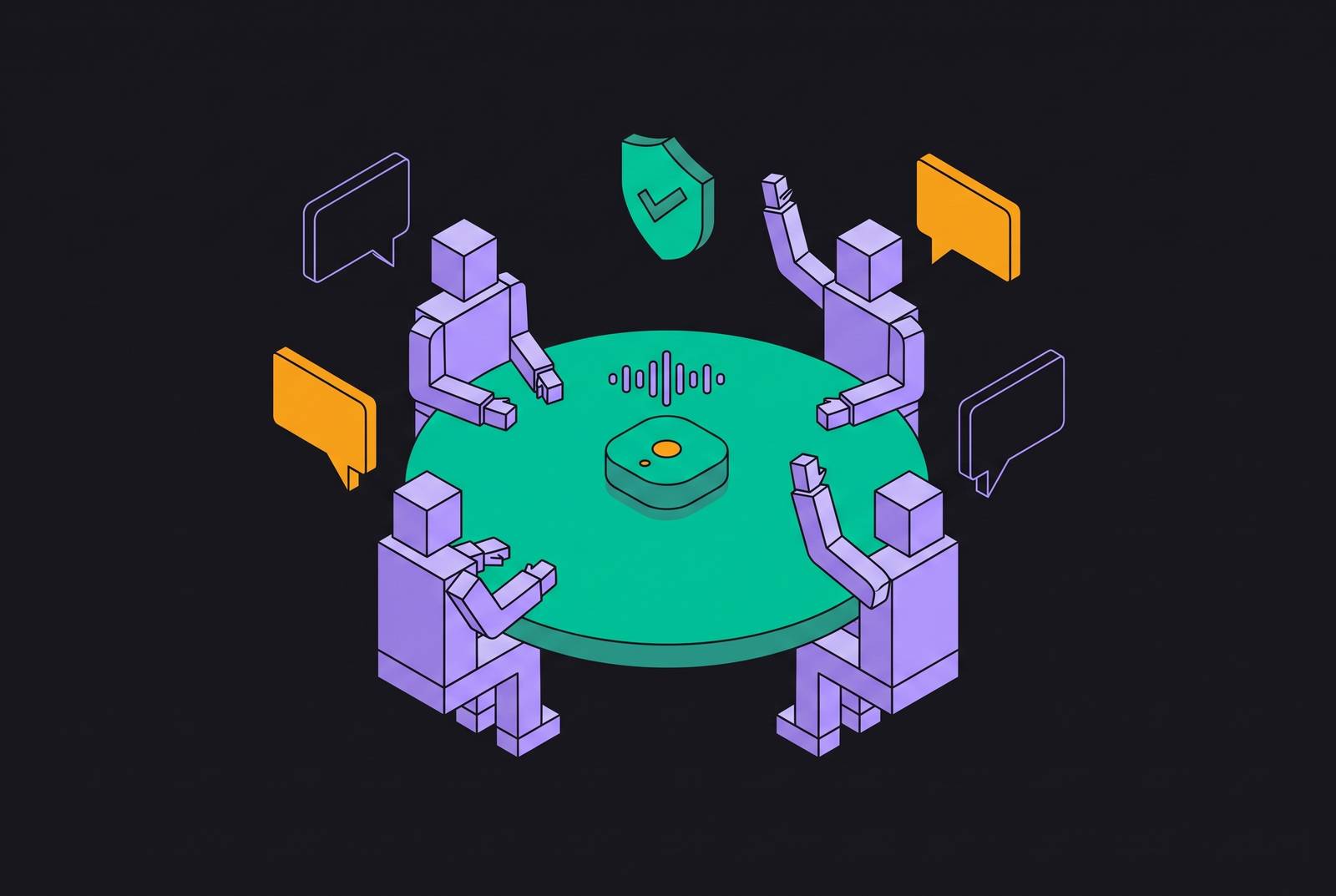
Handling Participant Objections to AI Meeting Recorders.
The three root causes behind objections to AI meeting recorders
Every objection to an AI meeting recorder sounds distinct in the moment. Someone says "I don't want to be recorded," someone else asks "where does this data go," a third person just wants to know who's going to see it later. Treated individually, these read like a scattered list of concerns requiring a scattered list of responses. They are not a scattered list of concerns requiring a scattered list of responses. Nearly all of them collapse into three root causes: surprise, uncertainty about what happens to the data, and a felt loss of control over one's own words.
Surprise does the most damage, because it hits before any explanation can land. A bot appearing in a call window mid-sentence, or a notification popping up once the conversation has already started, puts people on the defensive before the host has said a word about purpose or safeguards. Uncertainty about data compounds it: participants frequently have no idea whether the audio itself is stored somewhere, who has the login credentials to reach it, how long it sits on a server, or whether it quietly becomes training data for someone else's model. Telling someone "it's secure" doesn't touch that concern; it just restates the assurance in vaguer language.
The third root, loss of control, is the least discussed and probably the deepest. It's the sense that something permanent now exists of a conversation the participant expected to evaporate the moment the call ended. That matters more in exploratory brainstorms, candid one-on-ones, or anything touching legal or personnel territory than it does in a routine status update.
What the legal baseline requires before you record
None of this starts with AI. Recording consent law existed long before any notetaker could summarize a call, and AI tools simply step into obligations that were already written into state statute. A lot of the anxiety around AI notetakers gets framed as a novel problem, when really it's an old problem wearing a new interface.
In one country's legal system, the split runs between one-party consent jurisdictions, where a single participant, including the host, can record without telling anyone else, and all-party consent jurisdictions, where every person on the call has to agree before recording begins. As of now, the all-party states are California, Connecticut, Delaware, Florida, Illinois, Maryland, Massachusetts, Montana, New Hampshire, Oregon, Pennsylvania, and Washington. The odds of a call touching one of them are higher than most hosts assume.
Cross-jurisdiction calls complicate things further. A meeting with one participant in California and another in New York doesn't get to pick the more permissive rule; California's all-party requirement governs the whole call, because the stricter jurisdiction typically controls. Any team running client calls across state lines, or across borders, should treat that as the default assumption rather than an edge case worth checking later.
How bot-based and device-level capture create different consent dynamics
Two fundamentally different architectures exist in 2026: bot-based capture, where an external participant joins the video link, announces the recording, and processes audio on a cloud server, and device-level capture, where the application captures system audio directly from the user's computer with no external participant joining. Device-level capture works differently: the software pulls system audio straight off the host's own computer, and no separate participant ever joins the call.
The bot's visibility cuts both ways. On one hand, it functions as a built-in notice. Everyone on the call can see the extra name in the participant list, so recording is happening with little ambiguity. On the other hand, that same visibility makes some participants uneasy: a bot is a stranger in the room, an outside presence with no stake in the conversation, and its mere appearance can shift a candid discussion into a guarded one.
Device-level tools avoid that visual intrusion, but they trade it for a different obligation. Because nothing new joins the call, there's no automatic signal to the other participants that anything is being captured, which puts the disclosure burden squarely on the host. Tools built around this model, such as watermarks displayed on screen or an automatic chat message posted at the start of the call, exist specifically to close that gap.
The sharper distinction, though, is what happens to the audio itself after the call ends, and this is where the "who has my voice recording" fear actually gets addressed rather than deflected. Some device-level tools transcribe audio in real time on desktop and never store the raw audio at all; on mobile, audio may be cached briefly right after the meeting and then discarded, with only the transcript and notes retained. That's a meaningfully different privacy posture than a cloud-hosted recording sitting on a server indefinitely, and explaining it to a skeptical participant in exactly those terms matters, because "there's no recording to leak" answers the concern more completely than "the recording is protected" ever could.
Opening remarks before the meeting starts
The best way to handle an objection is to make it unnecessary. Disclose the tool, explain why it's there, and give people the choice to opt out before they're sitting in the meeting already feeling ambushed. That sequencing matters. An explanation offered after someone has already noticed the bot or the notification reads as damage control.
There are three roots (surprise, uncertainty about data handling, and loss of control over one's own words). The calendar invite is the first: a single line, something like "I use an AI notetaker to capture action items, let me know if you have questions or want it turned off," sets the expectation days before anyone dials in. The meeting chat at the very start of the call is the second, and it does double duty: it's a courtesy, and it leaves a timestamped record that disclosure happened, which matters if a consent question ever gets raised later.
Framing carries almost as much weight as the disclosure itself. "I'm recording this call" and "I'm using a notetaker so I don't have to type and can actually listen to you" convey the same underlying fact, but they land in completely different places, because the second one centers the participant's benefit rather than the host's convenience. People object less to being heard carefully than to being surveilled, and the language a host chooses signals which one is actually happening.
Whatever channel is used, it's worth covering who gets access to the output, whether that's just the host, the whole team, or the CRM. The verbal opening should be stated in the first 30 seconds, not buried in housekeeping, "Just so you know, I'm using [tool] to take notes so I can stay focused on our conversation".
Responding when someone objects despite advance notice
How a host responds to the objections that arise during a meeting, even after a well-run disclosure process, decides whether the meeting recovers or the trust in the room takes a permanent hit. A few objection types show up repeatedly, and each one is driven by a specific cause, not just a generic discomfort.
"I don't want to be recorded" is often really about the word "recorded" itself, or a fear about how long audio sits somewhere. Clarifying that only a transcript is retained, when that's true, resolves a large share of these on the spot, and pointing to a device-level tool that discards audio immediately addresses the concern at its root rather than talking around it. "Who sees this?" is a data access question, plain and simple, and it deserves a plain and specific answer: is it just the host, the wider team, a CRM, other AI systems the org runs? A vague "it's secure" answer doesn't just fail to help here, it actively makes the participant more suspicious.
"Will this be used to train AI?" is a legitimate, increasingly common question, and it requires the host to actually know the tool's data policy going in rather than improvising an answer under pressure. If the honest answer is "I don't know," say exactly that, and commit to finding out rather than guessing. "I need to speak freely in this conversation" is the candor concern in its purest form, and it deserves direct acknowledgment rather than dismissal: offer to pause the tool for the sensitive stretch of conversation, or turn it off entirely and take notes by hand for that one meeting.
"I didn't agree to this" is different from the rest, because it's a straightforward consent failure rather than a misunderstanding to clear up. If disclosure didn't happen in advance and someone raises it mid-meeting, the correct move is to stop the tool immediately and apologize for the process gap, not to explain why the recording is fine actually. The default whenever an objection surfaces, regardless of type, is to stop the tool first and have the conversation second; the relationship in the room outweighs any set of notes generated that day. What never works is arguing that the tool is "just" taking notes, minimizing the concern, or implying the objecting participant is overreacting. Those responses don't neutralize the loss-of-control fear, they confirm it.
Setting team-level norms so individual hosts aren't improvising every time
Inconsistency is its own trust problem. When one host discloses in the calendar invite, another mentions it only if asked, and a third doesn't mention it at all, participants experience that variation as unpredictability, and unpredictability reads as risk even when no single host did anything wrong. A written team norm removes the guesswork and takes the awkwardness out of what would otherwise be an individual judgment call every single time.
This isn't just good manners. The Wikipedia entry on AI notetakers points out that these tools can generate real legal and compliance exposure across participant notice and consent, data retention, vendor access, biometric data, confidentiality, and even attorney-client privilege. A written norm functions as the organization's first line of defense against exactly that list, and it's considerably cheaper to write the policy in advance than to reconstruct one after an incident.
Client-facing teams need a stricter version of the same norm, not a looser one. A team AI recording norm should cover what a team AI recording norm should cover.
Choosing the right tool posture for the meeting context
No single capture method fits every meeting, and treating the choice as one-size-fits-all is where a lot of avoidable friction comes from. The decision really turns on three variables: what participants already expect walking in, how sensitive the conversation is, and what the output needs to accomplish once the meeting ends.
For high-trust internal meetings, team standups, routine project syncs, a bot-based tool is often perfectly fine. The norm is already established, the purpose is unambiguous to everyone in the room, and the ability to route notes straight into a CRM or project tool makes the bot's visible presence a reasonable tradeoff. External client or prospect calls sit at the other end of the spectrum. A bot showing up as an unfamiliar name in someone else's sales call is close to the highest-friction scenario available, and device-level capture paired with proactive disclosure tends to generate far fewer objections, without giving up the ability to push summaries and action items into a CRM afterward.
Sensitive conversations, performance reviews, negotiations, anything brushing up against legal or HR territory, deserve a harder question before any tool gets turned on at all: should this be captured by automation in the first place? If the answer is yes, access needs to be locked down tightly, and the host should walk in with a retention and deletion policy already worked out, not one improvised in response to a question.
Participant entitlements and answers that build lasting trust
Participants asking what's captured, where it's stored, who can see it, how long it sits around, and whether they can opt out aren't being difficult. Those are due-diligence questions, and treating them as an inconvenience is a mistake that compounds rather than resolves the underlying distrust.
The answers that land are specific. "The transcript stays in my account, and nobody else sees it unless I share it with the team" reassures a skeptical participant in a way that "your data is safe" never will, because the first answer can be checked and the second one can't. Precision beats reassurance every time this question comes up.
The candor concern also deserves a straight answer rather than an argument. Some people genuinely speak differently once they know a transcript will exist afterward, and that's a rational adaptation, not a flaw in their judgment worth correcting. The way through it isn't persuasion, it's evidence over time: showing, meeting after meeting, that the notes serve the conversation and are never used as ammunition against anyone in it.
That track record eventually becomes the strongest case for the tool on its own terms. Once a team can search "what did we decide about this in March" and get an answer in seconds instead of reconstructing it from memory, the value stops needing to be argued for. One guide to AI notetakers observes that by around the twelve-month mark, new hires onboard faster simply by searching past meeting history, and institutional memory holds up even as individual team members leave and get replaced. And the downstream productivity case is not small: McKinsey's 2024 research on contact centers found that automating after-call work with AI carried the potential for a 30 to 45 percent productivity gain https://www.ringcentral.com/ai-transcription.html. None of that argument works, though, if the trust groundwork covered above never gets laid first. Top AI meeting transcription tools achieve accuracy rates between 90 and 95 percent or higher in English https://www.granola.ai/blog/ai-meeting-transcription-how-it-works-and-which-tools-lead-in-2026. Soundcore Work achieves a 95 percent accuracy rate across 100+ languages https://www.soundcore.com/blogs/voice-recorder/ai-voice-recorder-with-real-time-transcription.
Sources
- AI Voice Recorders 2026: Revolutionize Meetings & Notes
- AI Transcription Software [2026] by RingCentral
- AI notetaker - Wikipedia
- What Is AI Meeting Transcription and How Does It Work? - Sangoma Technologies
- AI Meeting Recorders and the Consent Problem Nobody Talks About
- AI Meeting Recording Laws by State: Complete Guide (2026)
- circleback.ai