Accent and Dialect Handling in AI Transcription Models
AI transcription tools hide lower accuracy on accented and non-native speech.
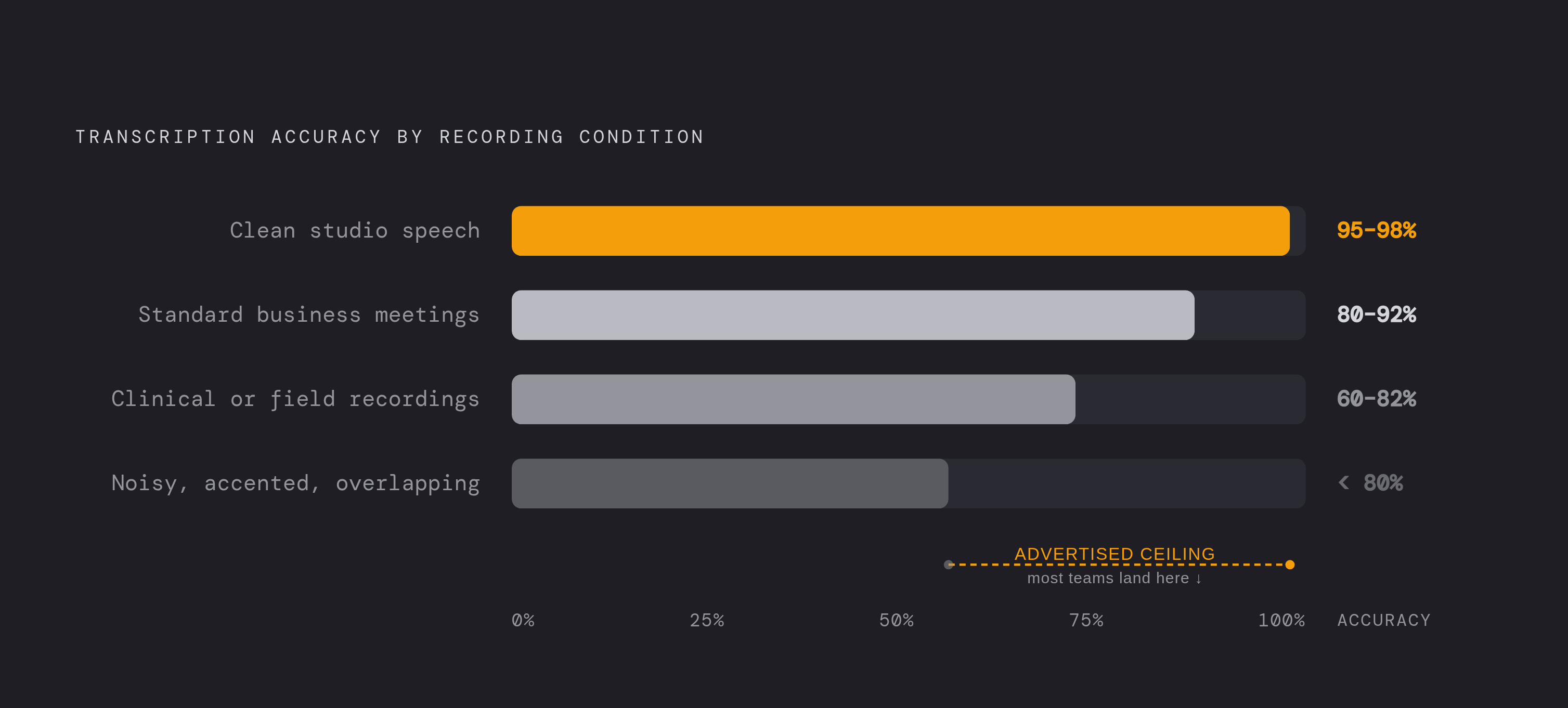
Vendors advertise 95 to 98 percent word accuracy, and that number is not a lie. Under studio conditions, with a single clear speaker and no background noise, top transcription models really do hit those figures. But real-world testing across business audio, the kind with crosstalk, laptop mics, and speakers from a dozen different language backgrounds, puts average accuracy closer to 61.92 percent. Both numbers are true. They just measure completely different things, and the space between them is where most transcription tools quietly fail the people who need them most.
How training data shapes AI transcription models
Most current transcription systems use end-to-end deep learning: a single neural network that takes raw audio and outputs text, rather than the older pipeline of separate acoustic models, language models, and decoders working in sequence. That shift raised baseline accuracy and gave models better contextual understanding of what's likely to come next in a sentence. But it also means the whole system's performance rides on one thing: what the training data actually sounds like.
A model learns phonetic patterns, rhythm, and vocabulary entirely from the audio it's fed. If that corpus is mostly broadcast-quality American or British English, scripted news reads, audiobook narration, podcast recordings from professional setups, then the model builds its sense of "normal speech" around those patterns. Anything that departs from them, a different vowel shape, a different rhythm of stress and pause, gets treated as noise to correct rather than signal to interpret. And the accuracy figures vendors publish are almost always measured on read corpora: scripted, clear, one speaker at a time. That's a controlled lab setting, quite unlike a Tuesday morning stand-up.
Transformer-based language models widened the range of speaking styles a system can handle, no argument there. But the gains aren't spread evenly. More training data helps widely spoken variants, like general American or British English, far more than it helps a speaker of one regional English variety or someone with a strong regional accent, simply because there's more of the former to train on. The rich get richer.
Where accent bias shows up in real transcription output
A standard measure of how many words a transcript gets wrong can vary sharply by accent, with meaningfully higher error rates observed for non-native English speakers using the same tool.
A study by McGuire tested current ASR systems against the L2-ARCTIC corpus, a dataset of speech from speakers whose first languages include Arabic, Chinese, Hindi, Korean, Spanish, and Vietnamese. On read speech, Whisper and AssemblyAI posted mean match error rates of 0.054 and 0.056, numbers that reflect strong performance on scripted material. The trouble starts once the speech stops being scripted. Research on clinical conversations has found error rates rise significantly for non-native speakers once the audio shifts from something read aloud to something spoken spontaneously, in a real clinical context with real clinical vocabulary. The same models that look near-perfect on a script degrade once you take away the script.
The failure patterns aren't random. Phoneme mismatches happen when a sound doesn't exist in the model's dominant training language, and the system maps it to the nearest sound it does know, sometimes producing a completely different word. Code-switching, moving between two languages mid-sentence, is completely ordinary in daily speech for vast numbers of multilingual speakers, as with Hinglish or Spanglish, and it confuses systems built around the assumption that one language is spoken at a time. Local idioms and dialect-specific phrasing trip models up too, and this isn't a pronunciation issue at all: it's a vocabulary gap, a phrase the model has simply never encountered in training. And once a model starts struggling with an accent, it tends to also mishear proper names and domain-specific terms, compounding the damage in exactly the moments (a client's name, a drug dosage, a technical spec) where accuracy matters most.
Aggregate WER hides all of this. A tool reporting a respectable average error rate might be running low errors on the easy stretches of a call and far higher errors on the accented speaker's turns. The average tells you almost nothing about who's actually being underserved.
"Noisy, accented, overlapping speech" as the normal condition in meetings
GoTranscript's 2026 benchmark guide lays out a tiered accuracy picture. Clean studio speech: 95 to 98 percent accuracy. Standard business meetings: 80 to 92 percent, usable but needing correction. Clinical or field recordings: 60 to 82 percent, with plenty of segments needing manual review. Noisy, accented, overlapping speech: below 80 percent, useful only as a rough guide to what was said.
Those degrading factors don't show up one at a time. A real call stacks them. Accent plus a laptop mic plus someone's dog barking plus two people talking over each other plus a load of industry jargon the model's never seen, all at once, in the same three-minute stretch. Each factor makes the others worse. A model already straining to parse a speaker's accent is far more likely to lose the thread entirely once that same speaker gets interrupted or has to compete with a barista machine in the background.
None of this is an edge case anymore. International teams are the default in modern organizations, not a special scenario to plan around separately. A company with offices in three countries and contractors in six more is going to have a call with a dozen different accents represented before lunch. The "clean American English" assumption baked into a lot of training data fails the exact use case that's now most common in enterprise software.
What improves accent handling and what vendors won't tell you
The clearest evidence-based fix is post-processing with a large language model after the initial transcription pass. It's post-processing with a large language model after the initial transcription pass. Research into clinical transcription has found that chaining a speech recognition system with LLM post-processing can meaningfully cut down accent-related errors in non-native speech. The logic is straightforward: the ASR model produces a rough draft, and the LLM then applies contextual reasoning to catch words that sound plausible but don't make sense given everything else in the sentence. This two-stage setup, ASR first, LLM correction second, is increasingly how production tools work behind the scenes. Vendors rarely explain this clearly, because "our transcript gets rewritten by a second AI before you see it" doesn't market as cleanly as "98% accurate."
Broader training data helps too, and by a meaningful margin: some transcription tools report accuracy gains of up to 30 percent on diverse accents once trained on more varied speaker data. The mechanism is unglamorous. It's not some architectural breakthrough; it's just more examples of more kinds of speech going into training.
Domain-specific fine-tuning matters as well. A model tuned on medical or legal vocabulary is less likely to botch a term it's actually seen a thousand times in training, which knocks out one of the compounding failure points before the accent challenge even kicks in. And better speaker diarization, the process of figuring out who's talking when, helps indirectly: cleaner separation of each speaker's audio means the model isn't trying to parse an accent and untangle overlapping voices in the same pass.
Evaluating an AI transcription tool on your actual speakers before you commit
No published benchmark replicates your team. That's not a knock on the benchmarks; it's just the nature of averages: they describe a population, not your Thursday sync with someone dialing in from one city and someone else from another.
Testing on your own audio takes five steps. Gather a representative sample with different accents, a mix of quiet and noisy rooms, real crosstalk, and the specific jargon your team actually uses. Get a human to produce a "gold standard" transcript of that same audio, something to measure against. Run the identical clips through two or three candidate tools, using the same settings you'd actually use day to day. Calculate WER, but don't stop at the aggregate number, because the average hides accent-specific failure. And look closely at which errors change meaning versus which are just cosmetic: a misheard drug dosage or a garbled name landing in a CRM record is a categorically different problem than a missing comma.
Beyond raw WER, check how the tool handles your domain's specific terms and names, whether speaker attribution holds up (misattributing who said what compounds every other error by mixing two people's words into one line), and whether the summary or action items generated afterward still make sense once the underlying transcript has accent-driven mistakes baked into it. As a working threshold: a WER above 25 percent on your own representative audio usually signals a transcript that needs to be substantially rewritten rather than lightly edited. Treat that as a reason to walk away, not just a data point to note.
What to look for in an AI meeting tool when your speakers include non-native English or regional accents
Most meeting notetakers on the market now run on a small handful of shared speech-to-text engines underneath. That's an important shift in how to think about them: differentiation has moved up a layer, into how the notes get structured, where they get sent, and whether an error in the transcript quietly propagates into an action item or a CRM field.
In practice, the leading tools mostly cluster around 90 to 95 percent-plus accuracy on English overall. Accent handling is where they actually pull apart from each other. A few product-layer features matter more once transcription accuracy is already under strain. LLM post-processing that corrects a phonetically plausible but contextually wrong word before a summary gets generated. Broad language support is a reasonable signal that a vendor trained on a wide range of speaker data, not just a narrow slice. The option to record without a visible bot joining the call, since some speakers, particularly non-native English speakers, talk more naturally and less guardedly without one. And integrations that let a corrected transcript flow straight into a CRM or project tool, so fixing an error once actually fixes it everywhere, instead of someone updating five separate systems by hand.
Tools that combine wide language coverage, both bot-based and botless recording, and direct integration into systems like HubSpot, Salesforce, and Attio, along with routing into Slack, Notion, or Asana, give teams with a wide range of speaker accents the best shot at turning an imperfect first-pass transcript into something accurate and actually usable downstream. That combination, language breadth, recording flexibility, and workflow automation that closes the loop, is the right thing to weigh heavily when accent coverage is a real concern for your team.
Setting realistic expectations and building a workflow that holds up across your whole team
For a team of mostly native English speakers talking in reasonably quiet conditions, AI transcription is dependable, everyday infrastructure at this point. It saves time, roughly the hours someone would've spent typing notes by hand, and doesn't ask much of you beyond a light skim.
For internationally diverse teams, the right bar to set is different: accurate enough to act on with a review step, not perfect and self-sufficient. That's not a small distinction, and treating it as one is how teams end up disappointed by tools that were never going to hit studio-grade numbers on real, accented, overlapping conversation.
A few habits make this workable in practice. Figure out, through your own testing, which speakers or meeting types produce the worst error rates, and build a human review step around those specifically rather than concluding the whole category of tool doesn't work. Favor tools that keep correction inside the existing workflow instead of forcing a round trip through some separate app. Treat the transcript as organizational memory rather than a courtroom-grade record: summaries, decisions, and action items tend to survive a rough WER better than exact quotes do. And for anything genuinely high-stakes, legal commitments, clinical documentation, financial terms, a hybrid approach, AI draft plus a human who actually reads it, remains the only method worth trusting fully.