Transcript Quality Benchmarks Across AI Meeting Tools
How vendors game accuracy claims and why your meeting audio tells a different story.
Meeting transcription accuracy numbers get thrown around like they mean one thing, but they don't. A vendor claiming 98% accuracy and an independent tester finding a much lower accuracy on the same category of tool are both telling the truth, just about completely different audio. The gap between those two numbers, and what causes it, matters more to anyone actually buying these tools than any single accuracy figure on a landing page. This piece breaks down how that gap forms, what drives it, and how to test a tool on the meetings that actually happen at your company rather than the meetings a vendor recorded in a quiet studio.
The stakes are only getting bigger. The meeting transcription market sat at $3.86 billion in 2025 and is projected to hit $29.45 billion by 2034, a compound annual growth rate that climbs well into double digits. That kind of growth pulls in more vendors, more marketing copy, and more accuracy claims fighting for the same eyeballs. Reported accuracy for AI meeting transcription tools spans anywhere from 82% to 98% depending on how and where you measure it, a 16-point spread that almost no vendor bothers to explain.
How transcription accuracy is measured, and what WER captures
The standard metric is Word Error Rate, or WER. It counts three kinds of mistakes, words swapped for the wrong word, words inserted that were never spoken, and words dropped entirely, then divides that total by the number of words actually said. Lower is better. A WER of 5% sounds close to perfect: 95 out of 100 words land correctly. Stretch that over a 60-minute meeting running several thousand words, though, and 5% error starts meaning dozens of wrong words scattered across the transcript, which is a different picture than the percentage alone suggests.
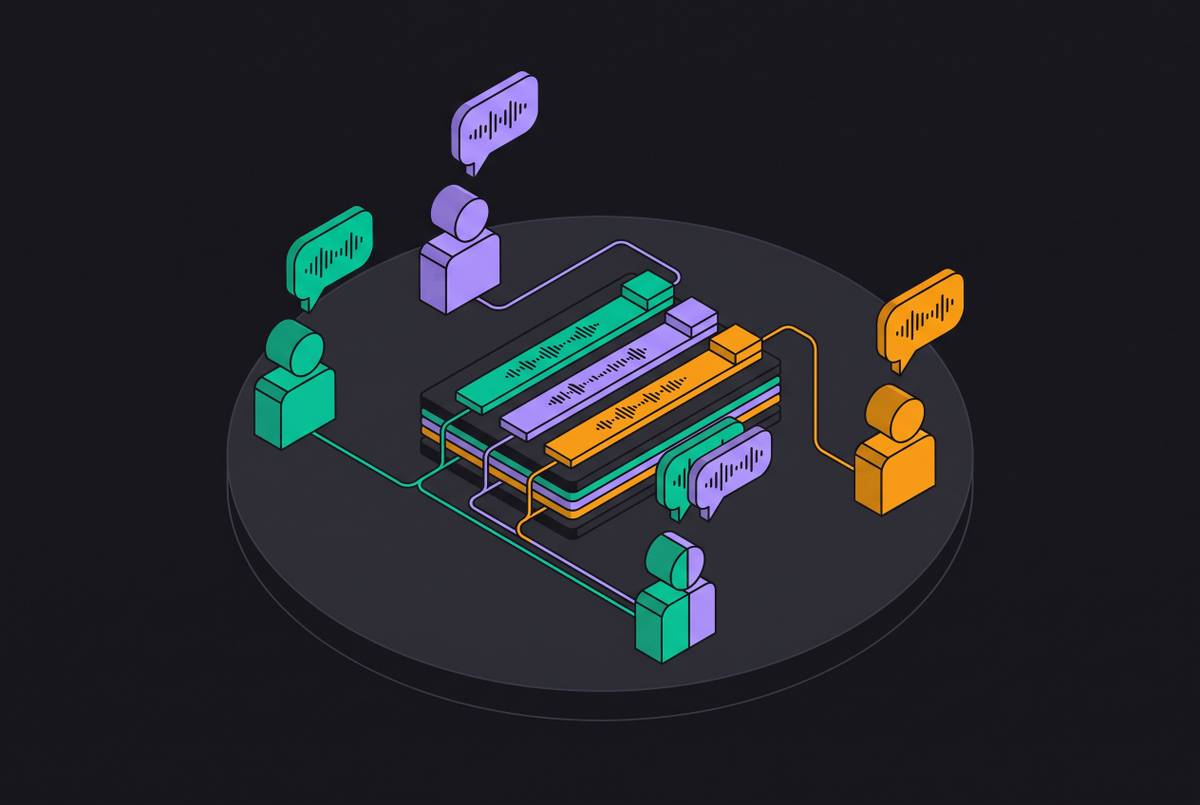
And WER, for all its usefulness, misses a lot. It says nothing about speaker diarization, meaning whether the system correctly figures out who said what, which matters enormously in a meeting where five people are talking and the notes get attributed to the wrong person. It says nothing about punctuation or formatting, so a transcript can score a low WER and still read as an unbroken wall of text nobody wants to open. It ignores how the system handles proper nouns, acronyms, and jargon, the exact vocabulary that makes a meeting transcript useful for a specific team, so a tool can nail conversational English and still mangle every product name and customer name in the call. And it handles overlapping speech by simply deleting words rather than flagging the collision, which can make a WER score look fine while the actual transcript loses entire exchanges.
Then there's the benchmark data itself. The standard tests, LibriSpeech, TED-LIUM, Common Voice, are built under controlled conditions that bear little resemblance to real meeting audio. None of that resembles a six-person video call where two people are talking over each other and someone's laptop fan is going in the background.
What leading ASR engines score, on the conditions they were tested under
On the clean end of the spectrum, current automatic speech recognition models are extraordinarily good. On the LibriSpeech test-clean benchmark, 2026 results put leading models including OpenAI's Whisper large-v3 in a low single-digit WER range, with other top models close behind. ElevenLabs' Scribe v2 came in at 2.3% WER, a 58% reduction in errors compared to IBM's 2024 benchmark of 5.5% on telephone speech, which is a meaningful jump in a short window. Multimodal models are entering the same territory: Gemini scored 2.9% WER, while NVIDIA's Canary landed at 5.63% on standardized datasets.
Move from read-speech benchmarks to conversational English, and the numbers shift, though not dramatically. AssemblyAI runs about 4.5% WER on conversational audio and roughly 6% once multiple speakers are involved. Deepgram is around 4.3%. OpenAI's base Whisper model runs about 5.1%. Google's Speech-to-Text is around 4.8% for conversational audio, but climbs to 6.8% once accented or non-native speech enters the picture. None of these numbers are bad. The problem is what happens next, once you leave the conditions these benchmarks were built on.
The specific conditions that degrade real meeting transcription, and by how much
Real meetings are messier than any benchmark dataset, and the accuracy numbers reflect that once you start segmenting by scenario. GoTranscript's 2026 analysis put standard business meetings at 80% to 92% accuracy, clinical and field recordings at 60% to 82%, and noisy environments with accents and overlapping speech below 60% in some cases. That's a wide band, and where a given meeting lands inside it depends entirely on room conditions, not on which vendor's logo is on the invoice.
A separate benchmark found 90% to 96% accuracy on clear audio with minimal background noise, dropping to 85% to 92% for challenging audio with background noise and overlapping speakers. Audio quality alone can account for up to 17 percentage points of accuracy difference, meaning the recording environment can matter more than which tool is being used.
Accents compound the problem. Even the strongest models show a 5% to 12% accuracy drop moving from standard American English to regional accents or non-native speakers. Major European languages generally stay within 2 to 3 percentage points of benchmarks in the most commonly used language, which is a reasonably small penalty. Less-resourced languages don't fare as well: drops of 5 to 15 percentage points against English benchmarks are common, a gap wide enough to make a tool genuinely unreliable for teams that operate outside the handful of languages ASR models are heavily trained on.
Multi-speaker meetings pile onto all of this. Overlapping speech triggers deletions, meaning words vanish from the transcript rather than getting swapped for a wrong word, and WER as a metric tends to under-penalize that kind of damage relative to how much it actually wrecks readability.
The divergence between vendor accuracy claims and independent test results
Independent tests on real-world business audio have found average accuracy far below the 95% to 99% numbers most vendor pages advertise. That's two different worlds, not a rounding difference.
The gap has structural causes. Vendors tend to run their own benchmarks on datasets their models were trained or tuned against, which naturally favors their own output. The academic datasets everyone cites, LibriSpeech and TED-LIUM among them, are built from read speech or studio-recorded lectures, nothing like actual meeting audio. And marketing materials tend to quote the top of a provider's performance range rather than the median a real customer will experience. Independent testers aren't immune either: their own audio samples may not represent typical conditions, and most testing methodology never gets published in enough detail to judge.
VexaScribe withdrew its July 2026 benchmark results after an internal review turned up methodology problems, an unusually candid move that says something about how hard it is to build a valid benchmark even when the intent is good.
What's genuinely interesting is where the numbers converge rather than diverge. On clean audio, the major providers now cluster tightly, delivering 95% to 99% accuracy with only 2 to 4 percentage points separating the leaders. At the top end, in other words, the accuracy race has basically been decided, and everyone crossed the finish line close together. What actually drives outcomes for a given team is the quality of the audio going in, not which vendor they picked. It's the quality of the audio going in.
The fragmentation of the tool landscape beyond raw transcription accuracy
Since accuracy has largely stopped being the differentiator, the market has split into distinct product categories chasing different jobs. What started as a single kind of product, a bot that shows up and produces a transcript, has broken into tools built around very different value propositions. Top tools in the category now cluster at 90% to 95%-plus accuracy in English, so the real question in 2026 isn't "how accurate is it" but "what happens to the notes after the meeting ends, and does a bot even need to join the call."
There's a tier built for individual productivity and free-tier accessibility, where fast processing and a generous free plan matter more than deep integrations; there's a tier built around pushing meeting insights straight into CRM and sales tools, where the value is in native connections to platforms like Salesforce or HubSpot rather than the transcript itself. There's a tier built for individual productivity and free-tier accessibility, where fast processing and a generous free plan let individual users get value without needing deep integrations. There's a tier built around pushing meeting insights straight into CRM and sales tools, where the value is in native connections to platforms like Salesforce or HubSpot rather than the transcript itself. There's a bot-free, privacy-first tier that captures audio locally without a bot ever joining the call as a visible participant, appealing to teams wary of an obvious third-party presence in every meeting. There's a broad cross-platform tier meant to work across whatever video tool a team happens to use, including in-person meetings. There's the platform-native option, where the transcription tool ships as part of the video conferencing suite itself rather than as a separate purchase. And there's a local, fully open-source tier for teams that won't send meeting audio to any third-party server at all, prioritizing privacy over convenience features.
The tools that lean hardest into workflow depth, structured note generation, automatic action-item capture, direct pushes into CRMs and project management platforms, treat raw transcription accuracy as a baseline requirement rather than a selling point. The competition has moved to what happens after the transcript exists.
What workflow integration does with transcript quality, and where it breaks
Once a note-taking tool joins a call, transcribes it, and summarizes it, the summary typically gets pushed into a matching record somewhere, a CRM entry, a project management ticket, a shared doc. Each step in that chain can inherit whatever errors happened upstream, and can also introduce new ones of its own.
The distinction between a note logged in an activity timeline and a value written into a structured CRM field affects how errors get caught and how much trust the data receives. A timeline note is something a human reads and can catch an error in. A value written into a mapped field, something used to trigger a workflow rule or populate a report, tends to get trusted and acted on without a second look, so a transcription error baked into a structured field can propagate quietly through a system for a long time before anyone notices it's wrong.
If a meeting participant joins using a personal email address that doesn't match the work email on file in the CRM, a lot of integrations respond by creating a brand-new duplicate contact and attaching the meeting notes there, rather than to the existing record. The real customer record stays untouched and stale, while the notes sit somewhere nobody's looking.
None of this is free. Gartner research cited by Sonix puts the average cost of poor data quality at $12.9 million a year for an organization, and inaccurate meeting transcripts feeding directly into CRM records and reports are one clear contributor to that number.
Benchmarking a transcription tool against your own meetings before committing
Given everything above, the sensible move is to test any tool on your own audio. Benchmarks built on LibriSpeech or a vendor's curated sample tell you almost nothing about how a tool will handle your team's Tuesday morning standup.
Your own audio means your worst realistic case, not your best. Pull a recording with several overlapping speakers, at least one international participant, some technical vocabulary specific to your industry, and ideally a remote caller on a noisy connection. If your team meets in person at all, include one of those recordings too, since room acoustics and microphone distance change results independently of which ASR engine sits underneath the product. And if your team operates in more than one language, test in those languages directly. A 5 to 15 percentage point accuracy drop on a less-resourced language, as noted earlier, is exactly the kind of gap that can quietly make a tool useless for half your meetings while still looking fine in a demo run only in English.
Beyond raw WER, track whether diarization errors are frequent enough to make a transcript genuinely confusing to read back, and count how often the tool mangles the specific product names, acronyms, and jargon your team actually uses. Those two things, more than any headline accuracy percentage, determine whether a transcript is something people actually trust and use, or something they quietly stop reading.
Sources
- 25 Meeting Transcription Adoption Statistics Every Professional Should Know in 2026 • Sonix
- AI Transcription Accuracy in 2026: Real Benchmarks & WER
- How accurate is speech-to-text in 2026?
- Word error rate is broken: How to actually evaluate speech-to-text in 2026
- What is word error rate (WER) and how do you use it
- gotranscript.com
- vexascribe.com