Reducing Hallucination in AI-Generated Meeting Summaries
Two-stage hallucination requires fixing both speech recognition and summarization separately.

AI-generated meeting summaries hallucinate at two distinct stages, when speech becomes a transcript and when that transcript becomes a summary. Better audio and speech recognition protect the source record, while transcript grounding and verification constrain what the summary can claim.
Why meeting summaries hallucinate — and why fixing "AI accuracy" in general does not fix it
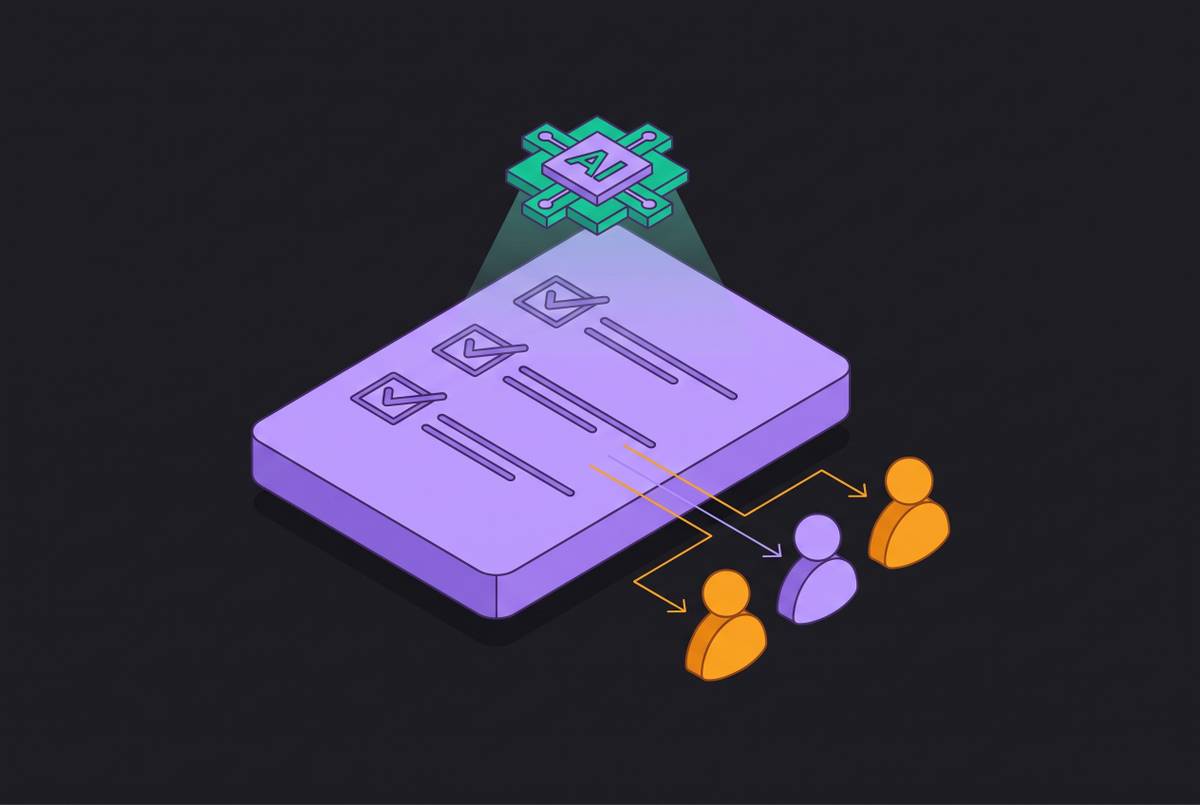
A meeting note assigns an action item to someone who was never in the room. The error appears in the summary, but that does not establish where it began. The transcription system may have introduced the name, or the summarization model may have supplied it while interpreting the conversation. Treating both as a general problem of “AI accuracy” obscures the point where the unsupported content entered the pipeline.
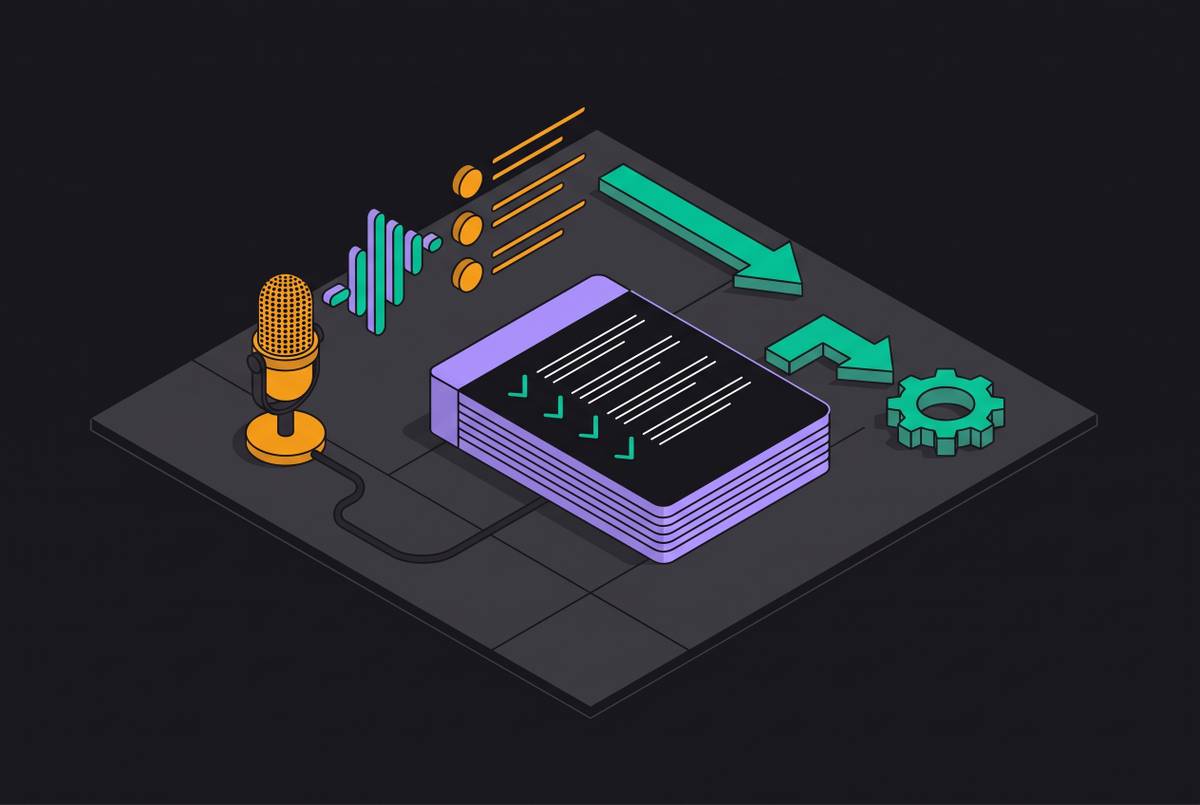
The pipeline has two sequential stages, which are speech-to-text transcription and LLM-based summarization. An uncorrected transcript error becomes input to the summarizer, where it can be carried into an otherwise faithful account. Conversely, even a perfect transcript does not prevent the summarizer from inventing a commitment or deadline. The first stage establishes the record available to the second, but neither stage guarantees the accuracy of the other.
That distinction limits what a model upgrade can accomplish. General improvements in LLM accuracy, including better benchmark performance and larger models, address the summarization stage while leaving speech recognition untouched. A team can therefore improve its summarizer and still receive notes containing names or figures that nobody said. In practice, how accurate the AI is matters, but so does where its claims first depart from the meeting.
What goes wrong at the transcription layer and why ASR models hallucinate
Automatic speech recognition, or ASR, can turn out text that reads smoothly and sounds sure of itself even though no one said it. This is structurally different from mishearing one word as another. The transcript introduces speech where the audio does not support it. Non-speech audio, silence, crosstalk, low-quality microphone signals, and heavy accents can trigger this failure when the model does not handle those inputs gracefully.
Bandwidth can vary on remote calls, while rooms where people meet in person add background noise. Multilingual participants and back-to-back speakers further complicate the signal the model must interpret. Under these conditions, grammatical completeness is not proof that recognition succeeded. A polished sentence can conceal an uncertain or unsupported reading of the audio.
Barański et al.’s research presented at Interspeech 2026 examines hallucinations in production ASR systems through a human-annotated dataset. Tripathi et al.’s 2025 paper, “Listen Like a Teacher,” proposes adaptive layer attention and knowledge distillation to mitigate ASR hallucinations. These model-level interventions matter because better recording conditions address only part of the problem. The model must also handle input that is unclear without turning it into text that sounds certain.
What goes wrong at the summarization layer and why LLMs hallucinate on meeting transcripts
At the summarization layer, the source of error changes from speech recognition to language generation. Summarization hallucination arises from how LLMs are trained, rather than from a failure to process the audio signal. Kalai et al.’s September 2025 paper describes how training objectives reward confident outputs over expressions of uncertainty. In a meeting summary, that tendency can produce a plausible commitment or attendee name instead of an acknowledgment that the transcript leaves something unclear.
Maleki et al.’s systematic review looks at how AI hallucination is defined in different uses, including text summarization, and shows that the term is used in different ways. For meeting records, the important distinction is between a statement that sounds reasonable and one that the transcript actually supports. A proposed deadline can be entirely plausible while still being an invention. The summarizer’s task is to preserve what the meeting established.
Meeting transcripts make that boundary difficult to maintain because they are long, loosely structured, and full of references such as “she said” and “that thing we discussed”. Working out what those references mean puts more pressure on the context-window and gives the model more chances to fill gaps from training memory. Liu et al.’s “Lost in the Middle” finding shows that facts in the middle of a long context are disproportionately likely to be ignored or distorted. This is a direct concern for hour-long meeting transcripts, where relevant context may be far from the statement it explains. The resulting summary can turn an unresolved reference into an assigned task or an unagreed dollar figure into a commitment.
Where hallucinated meeting content causes the most damage
The greatest damage occurs when an unsupported note moves automatically into a system that treats it as ground truth. CRM integration has at least three levels, including attaching a transcript link, logging notes and tasks to the correct record, and writing structured fields from meeting content. These levels carry different consequences because a link leaves the content available for reading, while a structured field makes the claim part of the record itself. A hallucinated commitment that populates a deal record is worse than an absent note because it supplies false certainty.
Sales teams face the highest risk in workflows that derive CRM updates from meetings. Invented deal stages, budget figures, or next steps corrupt records used for forecasting and handoffs. Customer success teams and founders are also exposed when they rely on meeting records to recover commitments and decisions. The shared vulnerability is dependence on a summary as evidence of what another person agreed to do.
Legal teams also face the risk of professional liability. The NYC Bar’s Formal Opinion 2025-6 calls for attorneys to check AI-generated recordings, transcripts, or summaries of attorney-client conversations themselves to make sure they are accurate. That duty is specific to those conversations, but it illustrates why meeting errors can exceed ordinary operational inconvenience. Searchable organizational memory extends the risk over time. A hallucinated commitment can resurface months later during onboarding or context retrieval as apparent evidence of a decision that was never made.
Fixing the transcription layer — what actually reduces ASR hallucination
Transcription controls begin with the input conditions that users can influence. Better microphones and less background noise help keep out signals that trigger hallucination. Speaker separation, with one speaker per audio channel where possible, helps the model tell speakers apart. Pre-meeting speaker enrollment gives the model voice profiles before people start talking. These measures improve the material available to ASR rather than asking the summarizer to repair an unreliable record afterward.
Cleaner input also needs a model that handles uncertainty well, since clean audio alone cannot change how an ASR system deals with it. Tripathi et al.’s 2025 work proposes adaptive layer attention and knowledge distillation to improve the model’s treatment of uncertain input. For buyers, handling silence and ambiguous audio is a model-quality question as well as a recording-quality question. Asking vendors how their systems handle non-speech audio gets directly at how the model handles it.
Evaluation should also examine what the transcript does when the audio deteriorates. Fluent, grammatically complete sentences in a visibly degraded stretch are a warning signal. Tests with accented and multilingual speakers matter for the same reason, since those conditions are part of the transcription risk described here. Language support is therefore a quality dimension to evaluate explicitly. The relevant standard is how faithfully the tool transcribes the speech a team actually produces.
Fixing the summarization layer — grounding, constraints, and verification
Once the transcript is available, the main control is to restrict summary claims to passages that support them. Retrieval-Augmented Generation, or RAG, grounds generation in retrieved transcript content. This counters the tendency to complete gaps with plausible material by giving the model a narrower evidentiary basis.
A citation contract makes that requirement explicit. Every factual claim must reference a retrieved passage by timestamp or speaker turn, and the model is instructed to abstain when no passage supports the claim. The reference gives a reviewer a place to inspect the evidence. Transcript grounding protects the second layer, while controls at the first remain necessary to establish that the transcript matches the audio.
Verification and monitoring support that contract. A draft can pass through a second stage that evaluates claims against the transcript and flags or removes unsupported content. Prompts can reinforce the boundary by prohibiting inference beyond the transcript and directing the model to express uncertainty. Faithfulness scores and an easy way to make corrections against the source let people keep checking the output. Together, grounding, citation discipline, and monitoring can substantially reduce hallucination, but they do not justify a claim that hallucination has been eliminated.
How MCP connections change the hallucination equation for AI assistants using meeting data
An assistant also needs grounding when it answers questions about past meetings. Without access to the relevant transcript, the assistant lacks the evidence needed to establish what was said or decided. A plausible answer does not become a meeting record simply because the question names a particular call. Retrieval changes the task from open-ended generation to answering from available source material.
Anthropic introduced MCP as an open standard in November 2024 to give AI assistants a standardized interface to external content. An MCP connection to a meeting tool lets the assistant access actual passages from the transcript. A question about what was decided on the Q4 budget in Tuesday’s call can therefore retrieve the relevant passage. This extends the RAG principle from summary creation to later queries across meeting history. The interface supplies access to evidence rather than making the assistant’s memory more reliable.
That distinction also defines the limit of the connection. MCP makes retrieval-grounded meeting queries possible, but access alone is not a guarantee that every answer is supported. The answer still needs the same constraints on unsupported claims and the same ability to point back to its source. If the retrieved transcript contains a transcription hallucination, the assistant is still working from a flawed record. MCP therefore extends the two-layer framework rather than replacing it with an infrastructure solution.
What to look for in a meeting tool if reducing hallucination is the goal
Buyers cannot look inside every tool’s ASR architecture or read its summarization prompt, but they can test where it goes wrong. At the transcription layer, evaluation should use real conditions, including accented speakers, multilingual participants, and degraded remote-call audio. Reading the transcript against low-quality stretches exposes suspicious fluency that a clean demonstration may not reveal. Vendor questions should focus explicitly on how the system handles non-speech audio.
At the summarization layer, ask whether generation is grounded exclusively in the transcript or can draw on general knowledge. Timestamp or speaker-turn references in summaries and action items show that the tool is citing its sources. A faithfulness score or a straightforward correction process supports review when the output departs from the source.
How deeply a tool is integrated then shapes how much other systems treat its claims as fact. A tool that writes structured fields in Salesforce or HubSpot carries a different risk from one that only attaches transcript links. That difference belongs in the evaluation because the same hallucination becomes more consequential when it directly changes an operational record. No current tool eliminates hallucination entirely. The sound buying standard is meaningful reduction through layer-specific controls, with evidence that both the transcript and the summary can be examined and corrected.