AI Notes for Board Meetings and Executive Briefings
Governance requirements make general AI note-takers unfit for board use.
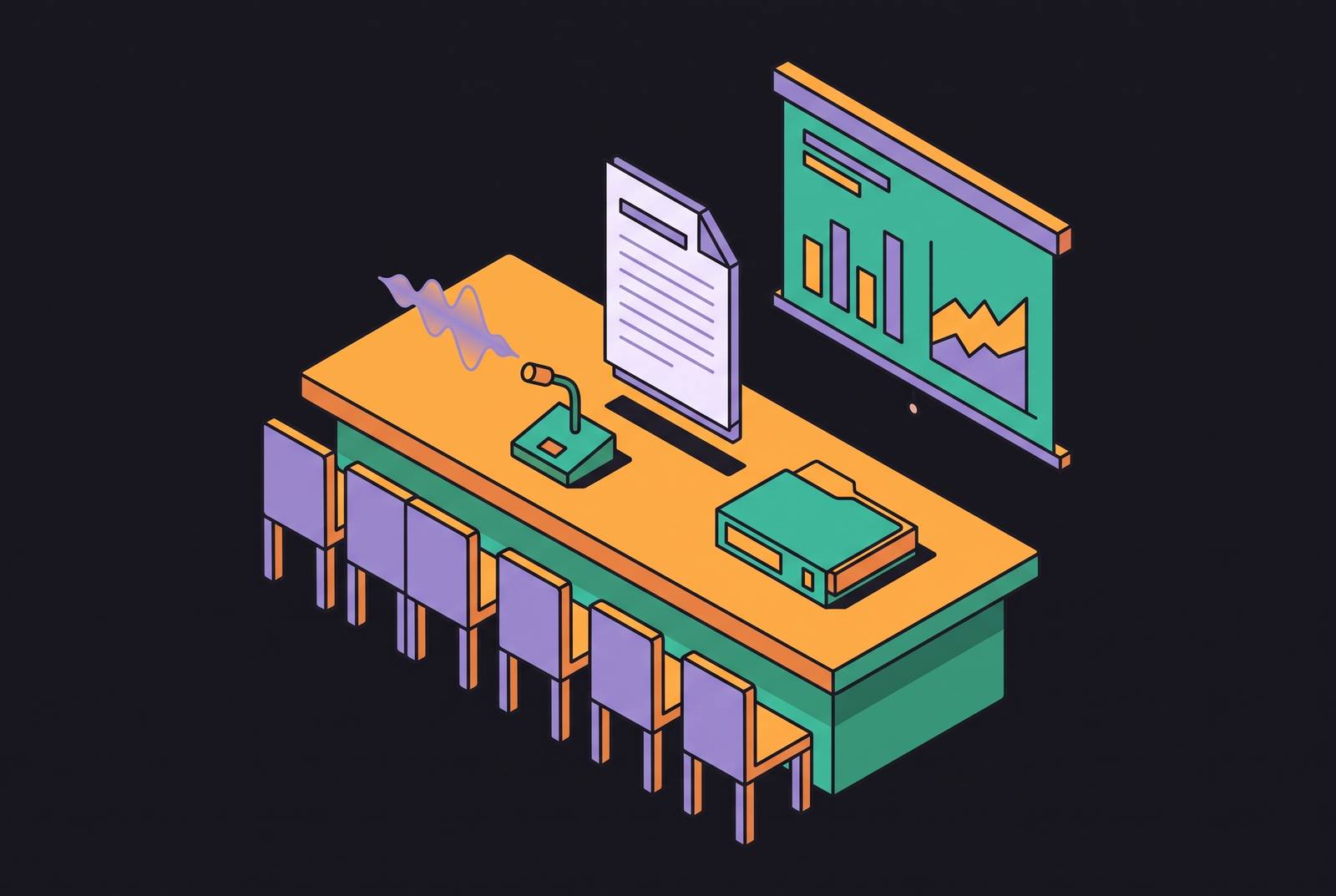
AI notes for board meetings and executive briefings must meet governance requirements. A tool used well creates the right record, keeps sensitive discussion safe, and helps people follow through on the decisions they are responsible for. A useful tool requires appropriate structure, data handling, and an approval workflow.
Why board meetings create documentation requirements that general AI note-takers were not designed to meet
A board can leave a meeting with a complete account of the discussion and still lack the document its governance process requires. General AI note-takers record how the discussion unfolds and what the action items are in working meetings. Board documentation serves a different purpose, which is to establish what the board decided and who bears responsibility. The required minutes are a fraction of a lengthy transcript, organized by agenda item and shaped by parliamentary convention.
Board discussions routinely cover M&A targets, pending litigation, executive compensation, and unannounced financial strategy. Unauthorized disclosure of that content can trigger legal liability, making confidentiality a condition of use. Tool evaluation must address both the formal record and the protection of the discussion from which it is made.
The transcript-versus-minutes distinction that determines whether AI output is usable or just voluminous
A transcript is a verbatim record, while minutes are an official record of decisions, motions, votes, resolutions, and assigned accountability. A transcript follows what was said, while minutes set out the formal outcomes of the conversation. For board meetings, compliance reviews, and regulated-industry settings, those outcomes must be structured, attributable, and stored according to a retention policy. A shorter transcript is not necessarily closer to usable minutes.
Producing minutes therefore requires more than summarization. The tool must pick out motions and votes, name the people responsible for decisions, and put the result under the agenda item it belongs to. It must also account for parliamentary procedure rather than flatten every contribution into a discussion point. Board Intelligence's Minute Writer and Diligent's board minutes tools are among the tools that governance professionals have designed to create this kind of record. Their role illustrates why a tool that summarizes sales calls well can still produce a legally inadequate board document if it cannot distinguish discussion from resolution.
The six requirements that actually determine fitness for board and executive use
Six requirements provide a practical framework for evaluating board and executive deployments. They are editable speaker attribution, decision and action tracking, minutes-ready structure, a human review and approval step, flexible capture options, and secure export with retention controls. Each addresses a separate way that useful-looking output can fail. Strong performance on one does not compensate for the absence of another.
Editable speaker attribution matters because identifying a voice is not the same as reliably identifying its owner. Sonix's advisory board guide stresses the need for speaker diarization in long sessions and says that how accurate it is in practice depends on the audio conditions. In multi-speaker sessions running two to four hours, mislabeling is a material concern, while transcription accuracy can drop to 80–85% with heavy accents, background noise, or simultaneous speakers. Minutes that attach a motion or vote to the wrong person are not simply imprecise but legally defective.
Decision and action tracking must separate a decision from a discussion point and a commitment from a suggestion. Minutes-ready structure must then place those outcomes in their proper formal context, or the organization inherits substantial rework. A human review and approval step prevents unexamined output from becoming the official record. Flexible capture lets people use a recording mode that both they and their security policies allow. Secure export and retention controls let the approved document move into governance systems while keeping the controls needed for legal hold and the obligations of the industry.
How capture architecture — bot versus botless — shapes what is possible in a confidential setting
How a meeting is captured affects both where sensitive audio goes and how freely people speak. A visible third-party recording system can prompt executives to self-censor, undermining the purpose of the discussion even when its technical security is acceptable. That behavioral effect makes architecture a governance choice. The choice must precede tool selection because it defines which forms of capture the meeting can tolerate. It also sets the starting point for examining consent and data handling.
In the dominant bot-based model, a third-party participant joins the call, audio streams to the vendor's servers, and output returns after processing. That model is efficient, but it introduces an external presence and sends sensitive audio outside the organization's environment. Botless capture can instead use a native platform integration or a local device. Decisions uses Microsoft Teams' built-in transcription engine, adds no external bot, and keeps what is said in the meeting within the organization's Microsoft 365 environment. This distinction matters for finance, legal, and public-sector boards where an external bot is uncomfortable or prohibited by policy.
For meetings held in person, another option is to record locally on a device. Audio remains on a physical device until the operator chooses to sync, supporting meetings in secure facilities without an available or permitted cloud connection. Local recording is one legitimate architecture whose suitability depends on the meeting's capture constraints and the handling requirements that follow recording.
Recording consent and data handling obligations that apply specifically to board-level meetings
A capture method that satisfies internal policy does not by itself settle recording consent. Recording laws apply to board meetings as they do to other conversations, but sensitive content raises the consequences of non-compliance. A visible bot is not a substitute for informed agreement. Explicit disclosure to every participant is required regardless of whether capture uses a bot, a native integration, or a device.
In the EU, AI note-takers used to evaluate or monitor employees may count as high-risk AI systems under the EU AI Act, which brings more rules to comply with. Retention policies must set out how long recordings and transcripts are kept and meet the requirements of litigation hold and the obligations of the industry. Leaving that policy unresolved at deployment creates exposure from the outset. These issues need a legal review of the specific circumstances, beyond a general assurance that recording is allowed.
Before deployment in a board or legal briefing context, legal and IT sign-off on the vendor's data processing terms, storage location, and retention controls is minimum due diligence. That review connects the sensitivity of the conversation to the actual handling of its record. It is not a formality to complete after capture has begun.
What security certifications and data handling commitments actually mean for boards evaluating a vendor
Security certifications are the minimum credible evidence that an independent audit has taken place. A claim of “enterprise-grade security” does not supply equivalent evidence for legal or IT review. Even an audited vendor, however, may have a data flow that does not suit a particular board. A vendor can be SOC 2 certified while processing meeting audio through AI models in jurisdictions that create regulatory exposure. Evaluation must therefore establish both where AI processing occurs and where the vendor stores data.
Retention commitments address a different part of the risk. Zero-retention options, under which source recordings and transcripts are not retained after processing, address residual exposure from a vendor breach or subpoena. Boards with the highest sensitivity requirements should verify whether this option exists and under what terms. The relevant distinction is between an available contractual commitment and a broad statement about privacy.
Day-to-day control depends on encryption at rest and in transit, configurable retention schedules, audit log export, and role-based access controls. These controls govern protection, duration, traceability, and access rather than serving as interchangeable signs of security. Their details need to be available before deployment so IT can evaluate the proposed workflow.
How the human review and approval step functions in a minutes workflow, and why it cannot be skipped
Once capture and processing are acceptable, the generated document still remains a draft. Treating it as official minutes creates a governance artifact whose accuracy the organization cannot vouch for. Board Intelligence's Minute Writer uses a convert-then-review workflow in which AI turns notes or transcripts into formatted minutes. The corporate secretary or board professional then edits and approves the draft before distribution.
Review is where errors that look minor in a summary receive their proper weight. A mislabeled speaker can misattribute a motion, an omitted seconder can leave its formal account incomplete, and an incorrect vote count can distort the outcome. These are defects in the record. The edit-and-approve stage provides the point at which a responsible person corrects them before the document is distributed.
Approval also establishes a chain of custody that supports the minutes' legal defensibility. A document with a named reviewer and an approval workflow has a different evidentiary status from output that was automatically generated and circulated. For boards that file minutes with regulators or courts, or face litigation over a decision, the workflow record matters with the document itself.
How AI meeting intelligence connects board and executive meeting output to the systems where decisions are tracked and acted on
An approved record establishes what happened, but it does not by itself cause commitments to be fulfilled. Board-level meeting intelligence often falls short when it comes to turning accurate minutes into action that can be tracked. A decision may be documented while its follow-through still depends on someone transferring it from a PDF. Integrations with CRMs, project management systems, and communication platforms can move action items, decisions, and commitments into the systems where owners work.
For executive briefings, this routing matters as much as capture. A commitment that does not reach the right owner's task system within hours is already at risk of being lost.
The Model Context Protocol extends access to meeting history through an MCP server. AI assistants can query the board and executive decisions made available through that server, so people can find them without searching separate systems by hand. They can surface what was committed to six months ago, who owns it, and whether it has been addressed. This makes past decisions available to later work, extending the value of the meeting record beyond its initial distribution.
Matching the right tool architecture to the specific meeting type — what boards, executive briefings, and legal sessions each require
The appropriate choice depends on which requirement governs the meeting. Formal board meetings need governance platforms built to produce minutes that follow the agenda and parliamentary procedure, with human review and approval. Diligent and Board Intelligence represent this category, where defensible workflow and formal output take priority over transcription speed. Daily executive briefings place greater weight on routing decisions and commitments into the systems where work is assigned. These are different output needs even when the participants overlap.
Advisory board and multi-expert sessions running two to four hours place particular pressure on attribution across a long, complex discussion. Tools for these sessions need strong multi-speaker diarization, support for long sessions, and enterprise security certifications. Sonix is positioned in this category for organizations prioritizing accuracy across languages and speakers. Its relevance follows from that meeting profile rather than from a general claim that one tool suits every executive setting.
Meetings with legal counsel or privileged discussion need more focus on botless capture, storage that is local or controlled by the organization, and an explicit review by an attorney of the vendor's data handling terms before the tool is used. The risk to privilege makes the data flow a deciding factor in the choice of tool. Organizations should therefore review the types of meetings they hold before choosing a single tool. Different categories may require different tools or different configurations of the same tool. The sound deployment is the one that matches capture, record structure, review, and follow-through to the obligations of the meeting.