Security and Data Residency Requirements for AI Meeting Vendors
Most AI meeting tools hide where your conversation actually goes.
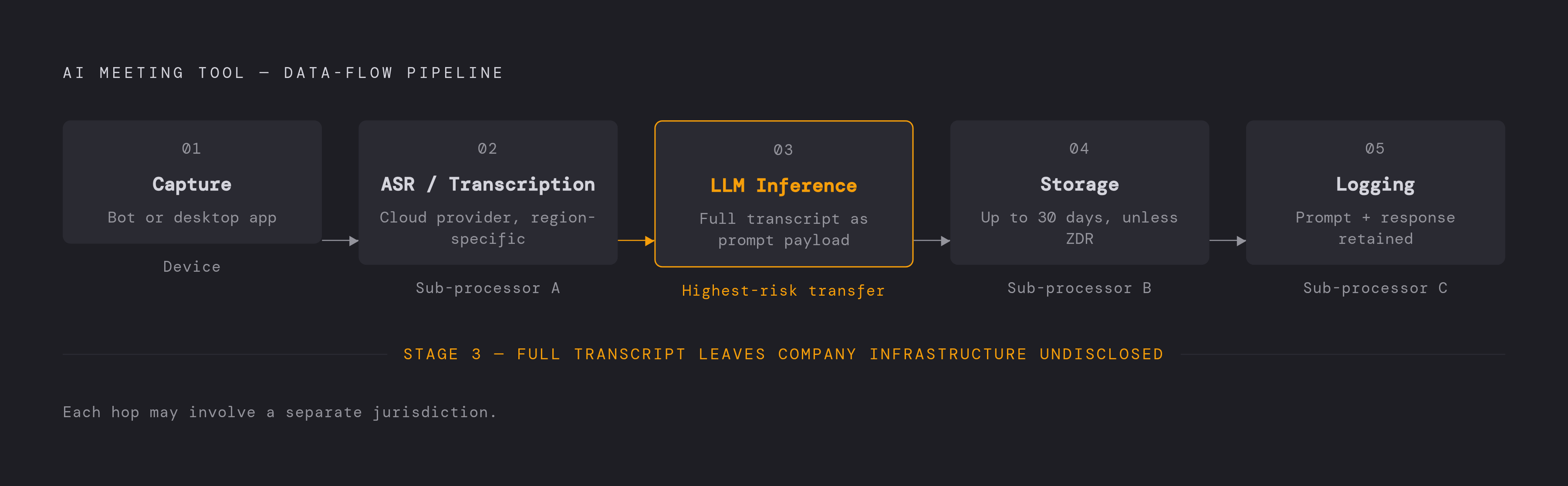
The compliance gap in AI meeting tools doesn't live in their certifications. It lives in the data flows those certifications were never built to cover. An AI meeting tool moves audio and text through at least three distinct layers: transcription (ASR), summarization (LLM inference), and storage, and each of those layers can involve a separate sub-processor sitting in a separate jurisdiction. A procurement team that stops at a standard security certification and a signed data processing agreement has done necessary work, but neither document tells anyone where the actual conversation ends up. The riskiest handoff in that chain is the LLM prompt payload: when a meeting tool generates a summary, the full text transcript gets sent over an API to a provider such as OpenAI or Anthropic, and most marketing pages never say so in plain language. Tools like Circleback lay out each sub-processor and its jurisdiction in writing, so enterprise teams get something to actually evaluate instead of a certification badge they have to take on faith.
Two other transfers get missed almost as often. Calling an embedding API sends document content outside company infrastructure to be vectorized, a step that rarely appears on a vendor's architecture diagram. Observability and logging tools used during development, such as LangSmith or Langfuse, can log full prompts and completions to their own servers; LangSmith's own documentation confirms that each LLM call sends the exact prompt text and the model's response to its servers, and Langfuse's security documentation states that it stores prompt and output data as-is unless redaction is turned on. Retention compounds the exposure. Most LLM providers hold prompts and completions for up to 30 days across their infrastructure by default unless Zero Data Retention is explicitly turned on, and even some ZDR-eligible setups carry exceptions: AWS Bedrock's retention documentation notes that certain Claude models require 30 days of retention with human review regardless of the account's data-handling mode. None of this requires a hostile actor. It only requires an employee letting a notetaker bot auto-join every meeting on a shared calendar, spreading an ungoverned data flow across the organization before procurement has looked at any of it.
What the regulatory environment now requires enterprises to document
The regulatory floor underneath meeting data has risen well past what a standard vendor security questionnaire asks for, producing obligations that stack on top of each other. Under GDPR, recordings, transcripts, and AI-generated summaries all count as personal data: names, voices, job titles, and opinions, with voice recordings and behavioral inferences drawn from meeting patterns drawing the closest scrutiny from EU regulators. Special category data under Article 9, things like health information or political opinions, can appear in an ordinary meeting transcript without anyone consciously disclosing it, and once it does, the handling requirements tighten automatically.
Lawful basis has to be documented before a recording starts, not written up afterward to justify one that already happened. Of the three bases enterprises most often reach for, legitimate interest requires a documented balancing test, contractual necessity applies narrowly, and consent carries its own trap: employee consent is frequently invalid under GDPR because the power imbalance built into an employment relationship makes a free refusal unrealistic. Legitimate interest is the more defensible basis for internal meetings, but it still demands a balancing test on file before rollout, not after a regulator asks for one. Organizations that record, transcribe, and AI-summarize meetings involving EU data subjects on a systematic basis are likely conducting "systematic monitoring of employees" under Article 35(3)(c), which makes a Data Protection Impact Assessment mandatory before deployment across the organization.
US state consent law runs alongside GDPR as a separate, parallel obligation. Cross-state calls should default to whichever state's consent rule is most restrictive; a visible bot sitting in a participant list does not amount to legally sufficient consent in any of these jurisdictions. Explicit disclosure is required no matter how the recording happens (Michigan's all-party status is contested in practice, with courts frequently applying a one-party standard to call participants instead). Professional ethics rules add a further layer on top of both: the NYC Bar Association's Formal Opinion 2025-6 found that lawyers must notify clients and obtain consent before recording with AI-enabled tools, and that failing to disclose is deceptive even when only a summary survives and the underlying recording and transcript get deleted, because a verbatim record existed at some point in the process and clients speak differently once they know one is being made. GDPR, the EU AI Act, state consent statutes, and bar association ethics rules can all apply to one meeting at the same time. Because recordings, transcripts, and AI summaries qualify as personal data under GDPR and fall under consent statutes in multiple US states, vendors selling AI meeting intelligence need to be specific about which data flows trigger which obligations, and how their product supports lawful basis documentation before an enterprise turns it on for everyone.
The unsettled EU-US data transfer question
Choosing an "EU region" setting in a vendor's console does not by itself establish data sovereignty if that vendor is headquartered outside the EU, and the legal framework most such vendors lean on for cross-border transfer is still being argued over in court. The US CLOUD Act lets American law enforcement compel US companies to hand over data stored abroad, even when the servers sit physically inside the EU, because legal jurisdiction follows the company's home country, not the location of the hardware.
Marketing copy tends to blur three concepts that are legally distinct. The physical location of data is what residency describes. Data sovereignty describes whose laws actually govern that data. Data localization describes legal mandates that require data to stay inside specific borders. An AI meeting tool has to satisfy all three at multiple points along its pipeline: storage of the audio and transcript, the location where the LLM runs inference to produce a summary, any fine-tuning on top of that, and the logging of outputs afterward. A vendor can offer EU storage for recordings while routing the LLM summarization step through infrastructure outside the EU, and still call the product "EU resident.
The EU-US Data Privacy Framework remains the adequacy mechanism most US vendors rely on, and as of September 2026 it is still in force. A challenge to it is on appeal before the EU Court of Justice under case C-703/25 P, and a June 2026 US Supreme Court ruling touching the FTC has raised fresh questions about the oversight structure the Framework depends on. Where the Framework doesn't apply or is being actively contested, Standard Contractual Clauses require a case-by-case Transfer Impact Assessment that documents the legal situation in the destination country along with any supplementary safeguards, and that assessment is an obligation that sits with the controller, not something a vendor can complete on the customer's behalf. The strongest position for an organization that can't accept transfer risk at all is true EU data residency, meaning both storage and inference running on infrastructure physically inside the EU, which removes the transfer question for the data it covers. A vendor's claim of EU data residency says nothing on its own about whether LLM inference, fine-tuning, or output logging happens somewhere else entirely; you need to check each stage of the pipeline separately, since each one is its own transfer point.
Sub-processor chain coverage in a compliant vendor DPA
A signed Article 28 DPA is where vendor evaluation should start, not where it should end. The terms most often missing or too thin to rely on are sub-processor coverage, retention language specific to LLM processing, and the right to delete individual records on request. A DPA worth signing specifies the subject matter of processing, its duration, the nature and purpose of the processing, the types of personal data involved, the categories of people whose data is affected, the processor's obligation to act only on the controller's documented instructions, and a commitment to delete or return data at the end of the contract with written confirmation that it happened.
Sub-processor disclosure is where most AI meeting tool DPAs fall apart under scrutiny. Every sub-processor in the chain, whether that's the ASR provider, the LLM provider, cloud storage, or an observability tool used in development, needs its own Article 28 contractual safeguards, not an assumption that the primary vendor's terms cover the whole chain by extension. The vendor needs to give advance notice before changing a sub-processor and a real opportunity to object to it, not a notice buried in a changelog. Standard Contractual Clauses have to reach every data flow in the pipeline, meaning raw audio, transcripts, summaries, and the LLM prompt payloads themselves, not just the relationship with whoever stores the recordings.
Before you sign anything, look hard at two terms specific to LLM processing. A binding commitment that meeting content isn't used to train AI models has to come from the LLM sub-processor directly, not only from the meeting tool vendor repeating the sub-processor's policy back to the customer. OpenAI's own documentation describes its business data controls as letting qualifying organizations configure retention, including a zero-data-retention option, which confirms that retention and training are separate settings governed separately. A vendor saying it doesn't train on customer data says nothing about how long that data sits on a server before deletion. Both statements can be true of the same system at once, and a DPA needs to pin down the retention window at each sub-processor in actual days, not describe it in general terms.
Two practical checks round this out. Confirm the DPA exists as a standalone document or a formally attached addendum rather than language buried inside a general terms-of-service page, since an auditable obligation needs to be a document someone can point to. Check whether the organization has ungoverned meeting tools in use that nobody in IT or legal signed off on, because if employees are running shadow tools, you can't locate every record tied to a GDPR deletion request. The entire DPA framework assumes centralized deployment, and it breaks down the moment that assumption stops being true.
The real-world compliance consequences when the data-flow gaps go unchecked
The compliance failures that have shown up at organizations using AI meeting and AI data tools followed directly from the architecture of those tools, not from any intent to do harm. The clearest example so far comes from Community Bank, a subsidiary of CB Financial Services. On May 5, 2026, the bank detected a cybersecurity incident caused by an unauthorized AI application, which exposed customer names, Social Security numbers, and dates of birth. The company determined the incident was material based on the sensitivity and volume of the data involved, despite there being no disruption to banking operations, and the filing does not claim the data was never misused, only that the investigation was still open. The incident triggered an SEC 8-K filed under Item 1.05, the first such filing to attribute material risk to shadow AI use.
Meeting notetakers cause this kind of incident because of how they work. Unlike a general-purpose AI tool that needs an employee to copy and paste something into it, a notetaker captures the full audio stream automatically for the length of a call, with no separate action required from anyone in the room. Litigation has followed a similar pattern elsewhere. In litigation against another vendor, Google LLC, plaintiffs alleged that Google's Cloud Contact Center AI intercepted and transcribed customer service calls in real time without all-party consent, violating the California Invasion of Privacy Act, a claim that shows transcription at scale creates legal exposure even for a vendor with Google's resources behind it.
Attorney-client privilege carries its own version of this risk. When an outside AI provider processes meeting audio or a transcript, that provider can end up legally outside the attorney-client relationship altogether, and depending on what safeguards were in place, its involvement can amount to a waiver of privilege. The NYC Bar's Formal Opinion 2025-6 was written to address this exact risk.
Verification at each layer of the data flow
A rigorous vendor evaluation follows the data itself, not the vendor's marketing claims about it. At each layer, capture, ASR, LLM inference, storage, and any MCP or integration endpoint, there's a specific question a DPA or a trust page can't answer by itself.
At the capture layer, the first question is whether the tool joins meetings as a visible bot or captures audio silently through a desktop app, since each carries different consent implications: a visible bot gives participants a moment to notice and object before the meeting starts, while silent desktop capture puts the entire burden of disclosure on the organization that deployed it. Admins should be able to check whether the tool auto-joins every calendar event by default and scope that behavior down or turn it off at the organization level. The third is whether admins can set a bot name, control the in-meeting notification text, and pause or resume capture for sensitive portions of a conversation.
At the ASR layer, the central question is whether transcription happens on the device itself or whether audio gets sent to a cloud ASR provider. If it's sent to the cloud, the next questions are which provider handles it, in which region, and under what retention terms; an on-device transcription step removes an entire transfer point from the compliance picture because it never sends the raw audio anywhere. Carrying that same discipline through the LLM inference layer, the storage layer, and any integration endpoint, rather than stopping at the first cloud hop, is what separates a vendor evaluation grounded in the actual architecture from one that stops at a certification badge and a signed form.