GDPR Compliance for AI Meeting Tools in European Enterprises
Five legal tests separate compliant AI meeting tools from exposure in European enterprises.
GDPR compliance for AI meeting tools in European enterprises turns on five specific mechanisms: lawful basis, the vendor DPA, the sub-processor chain, cross-border transfer instruments, and consent design at the point of recording. Most enterprise teams treat this as a vendor security questionnaire. It is instead a set of distinct legal tests, each with its own failure mode, and most tools and buyers fail at least one of them in predictable ways.
The distinct GDPR exposure of AI meeting tools
When a bot joins a video call, it captures audio, sends that audio to a cloud server, runs it through a transcription engine, and passes the resulting text to a language model that generates a summary and a list of action items. Each of those steps, capture, transmission, processing, storage, and routing to whatever CRM or Slack channel sits downstream, is a separate act of processing personal data under GDPR, and each one needs its own documented legal basis. That is the architecture nearly every AI meeting tool on the market uses, and it produces the exposure.
The data flowing through that pipeline is not one thing. A single meeting session generates names, voices, job titles, opinions people stated out loud, and sometimes health information or strategic business details that came up in conversation. All of it counts as personal data under GDPR. Voice recordings count as personal data on their own, but if you process the audio to identify who is speaking, it becomes biometric data, so Article 9's special category protections kick in and the requirements get stricter.
European data protection authorities focus their scrutiny on three outputs from that pipeline: the raw voice recording, the verbatim transcript, and the behavioral inferences a system draws from patterns across meetings, who talks most, who gets interrupted, who misses meetings. Each of those three may need its own legal justification, not one blanket justification covering the whole session. That distinction is what a generic data-privacy checklist misses: it treats "the meeting recording" as a single artifact, when GDPR treats it as several, layered obligations stacked on top of each other.
Lawful basis and why employee consent almost never qualifies
GDPR Article 6 says you need a documented lawful basis before processing starts, not after. An organization cannot record a meeting first and work out the justification later. You have to decide the basis, write it down, and have it ready before anyone joins the call.
Three bases cover most enterprise meeting recordings. Legitimate interest is the usual default for internal business meetings, but it only works if there's a documented balancing test on file showing the business need outweighs the privacy interests of the people in the room, and that document has to exist before the meeting, not get drafted after a complaint. Contractual necessity applies only when you actually need the recording to perform someone's contract, a narrower bar than most teams assume, so recording that is merely useful for managing a contract doesn't meet it. Consent is appropriate only where recording is genuinely optional and a participant can say no without any professional consequence.
That last condition is where most internal deployments go wrong. When an employer records its own employees, consent is frequently invalid under GDPR, because the employment relationship carries a power imbalance, and that keeps employees from refusing freely. A data protection regulator's guidance on consent says exactly this, and enforcement decisions have been built on that reasoning. An employee who is nominally free to decline a recorded meeting but knows that declining could affect how they're perceived has not given consent that GDPR recognizes as valid. For recording employee meetings, legitimate interest or a specific legal obligation holds up far better than consent, and it holds up precisely because it doesn't depend on a freedom of choice the employment relationship doesn't actually provide.
The basis you pick doesn't carry over to every downstream use of the data. If you justify a recording under legitimate interest for accurate meeting notes, you can't then keep the summary indefinitely or feed it into a separate AI workflow for performance analysis. Processing documentation should state the basis, the purpose, and the retention period separately for the raw audio, the verbatim transcript, and the structured summary, because each of those three is treated as its own processing activity.
What Article 28 requires from a vendor DPA, and what most agreements leave out
Once an organization has settled its own lawful basis, it needs the agreement governing the vendor that processes the data on its behalf. Article 28 sets out what a valid Data Processing Agreement has to contain, but most enterprise buyers never check their vendor's DPA against that list.
A DPA has to specify the subject matter, duration, nature, and purpose of the processing, along with the categories of data and data subjects involved. It has to state that the processor will act only on the controller's documented instructions and won't use the data for its own purposes. It has to set out sub-processor disclosure and approval rights, so you get advance notice before a new sub-processor is added. It has to describe the technical and organizational security measures required under Article 32: encryption, access controls, incident response procedures. It has to commit the vendor to helping you respond to data subject requests, deletions and access requests from employees or meeting participants. And it has to specify what happens to the data at the end of the contract: deletion or return, with written confirmation that any copies held by the vendor have been destroyed.
Any DPO or legal counsel can run a vendor's actual document against that list, point by point, and quickly see whether it holds up. A DPA folded into a general terms-of-service page, rather than issued as its own document or a formally signed addendum, is harder to produce as evidence if a regulator ever asks for it, and that format choice alone can undercut an otherwise reasonable agreement. If you leave out any one of the elements above, the agreement becomes non-compliant, no matter how confidently the vendor's marketing describes its GDPR posture.
Even if a DPA checks every one of those boxes, it only governs the primary vendor relationship. It says nothing about who else touches the data after the primary vendor has it. That is where most of these agreements actually fail.
The sub-processor chain, where DPA compliance breaks down in practice
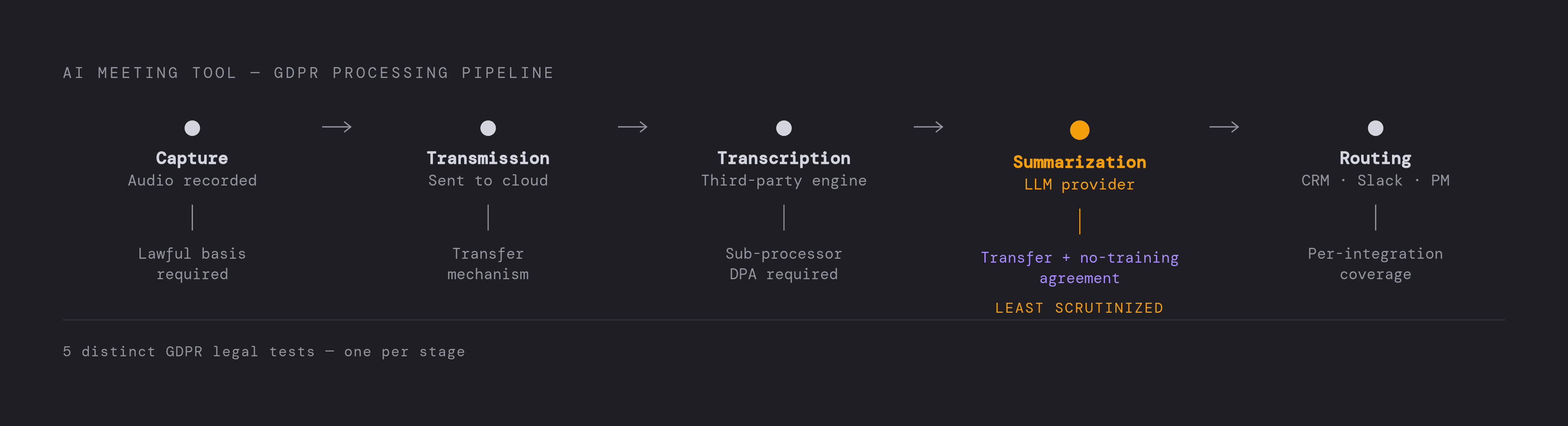
An AI meeting tool is a chain: the primary vendor that sells the product, the transcription engine turning audio into text (often a third-party model licensed in, not built in-house), the large language model provider generating the summary and action items, and whatever CRM, project management tool, or Slack integration receives the output afterward. Every link in that chain that touches personal data outside the EEA needs its own valid transfer mechanism; it can't just inherit one from the vendor at the top of the chain.
The LLM layer is the newest and least scrutinized part of that chain. Many enterprise buyers check the primary vendor's DPA, confirm it looks reasonable, and stop there, without asking which model generates the summary, where that model's provider is based, or what happens to the transcript once it's been sent for summarization. A standard transfer mechanism has to cover every data flow in the chain, the raw audio, the transcript, the summary, and anything routed to an LLM provider for processing, and each sub-processor needs to be covered by the same or an equivalent transfer mechanism as the primary vendor, not assumed to inherit one by association.
A compliant sub-processor disclosure, in practice, looks like a short, specific set of things a buyer can ask to see: a current, publicly available list of every sub-processor involved, including the LLM providers generating transcripts and summaries; each sub-processor's jurisdiction and the transfer mechanism covering it if it sits outside the EEA; a contractual requirement that the vendor give advance notice before adding a new sub-processor, since a static list sitting in a legal archive with no notification process is exactly the kind of gap a DPO flags during a review; and binding no-training agreements with any AI sub-processor, ideally paired with zero-retention commitments for the data passed through it. Zero-retention commitments matter specifically because they reduce exposure under the data minimization principle: data that isn't retained can't later be breached, repurposed, or memorized into a model.
Cross-border transfer mechanisms after Schrems II
Every sub-processor that sits outside the EEA needs a transfer mechanism that actually holds up, and the law on which mechanisms qualify has kept shifting. The 2020 Schrems II ruling struck down the EU-US Privacy Shield. Its replacement, the EU-US Data Privacy Framework, is still in force as of September 2026, but it remains under active legal challenge: case C-703/25 P is on appeal before the EU Court of Justice, and a June 2026 US Supreme Court ruling touching the FTC's authority has raised new doubts about the oversight mechanism the Framework depends on.
Two mechanisms remain available to US-based vendors. Certification under the EU-US Data Privacy Framework covers the transfer for vendors that qualify, but that coverage rests on a legal foundation whose stability isn't guaranteed given the pending appeal. A standard transfer mechanism paired with a documented Transfer Impact Assessment remains the more durable foundation for procurement, because it doesn't depend on the outcome of litigation still working its way through the courts.
Storing data on servers located in the EU while the actual processing, the transcription or summarization step, runs on US-based infrastructure does not close the transfer gap, and the Schrems II analysis attaches to the processing step itself, not merely to where the data is stored at rest. A vendor that advertises "EU data storage" while routing audio through a US-based transcription API has not resolved the transfer issue; it has relocated where the unresolved issue sits.
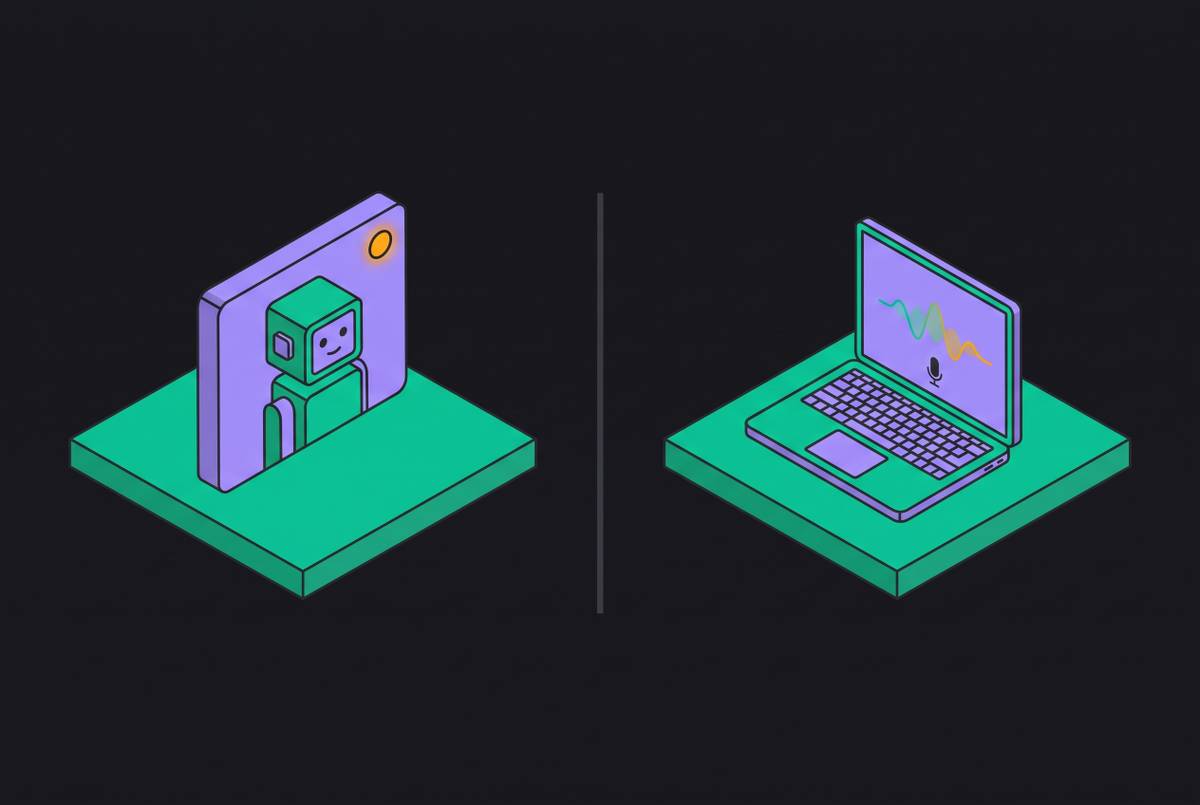
Two architectural choices actually change the risk profile. With on-device transcription, speech-to-text conversion happens locally and only the resulting text gets sent onward, so the raw audio never crosses a network, and that eliminates the audio transfer risk because the biometric exposure that comes with voice data never gets created in transit. True EU data residency, meaning both storage and AI processing run on infrastructure physically located within the EU, takes the transfer question off the table altogether for the data it covers, and of the options available today, it is the architecture an enterprise DPO can sign off on with the least reliance on legal instruments that might not survive the next court ruling.
Why a DPIA is mandatory before enterprise deployment
The lawful basis decision, the vendor DPA, and the sub-processor and transfer analysis all feed into a single procedural requirement most enterprise buyers skip: the Data Protection Impact Assessment under Article 35 GDPR. A DPIA can't be completed without the vendor's technical and organizational measures documentation and its sub-processor list in hand.
A DPIA is mandatory whenever processing is likely to result in high risk to the rights and freedoms of natural persons, and deploying an AI meeting assistant that records and analyzes conversations at enterprise scale typically meets that bar, though not automatically in every case. Germany's Data Protection Conference (the DSK) has stated that a DPIA will often be required when deploying AI applications processing personal data. AI meeting tools tend to satisfy all three of the triggers listed in Article 35(3): systematic and extensive evaluation of individuals through automated processing with legal or similarly significant effects on them, large-scale processing of special category data (voice data processed for speaker identification falls here), and in some deployments, systematic monitoring of a space accessible to the public.
A DPIA for this kind of tool has to assess the necessity and proportionality of the processing against its actual purpose, the technical and organizational measures in place to manage the risks it identifies (encryption, role-based access, audit logging, documented retention and deletion schedules), and whether a human reviews AI-generated outputs before anyone acts on them. That last condition isn't incidental: Sweden's data protection authority, IMY, attached exactly this condition when it found that AI transcription of sensitive data could be lawful, and separately identified automation bias in AI-generated outputs as a risk organizations have to manage through training, time allocation, and clear internal procedures.
The DPIA process also exposes a risk that otherwise stays invisible: shadow IT. If employees are using AI meeting tools the organization never approved or inventoried, there is no way to locate every recording and transcript that exists when a deletion or access request comes in. Running the DPIA properly forces the inventory that makes that request answerable.
Consent design and participant notification, where compliant intent breaks down
An organization can have a sound lawful basis, a DPA that satisfies Article 28, and a completed DPIA, and still fail at the point where a meeting actually starts, because none of that legal groundwork executes itself. If you want compliant participant notification, you tell people before processing begins, not after the recording is already running behind a banner. It means stating what will be captured, how it will be processed, who gets access to it, and how long it will be kept.
A short spoken notice at the start of a call can work, but only as a pointer toward a fuller privacy notice covering purpose, retention, and rights elsewhere, and delivering that notice is the controller's obligation, not something a piece of software can discharge on its own. Whether the recording bot is visible also carries real weight: a bot that joins a call and sits visibly in the waiting room until someone admits it creates a natural point where participants see it before it starts recording, and in jurisdictions that require consent from multiple parties, the decision to admit it carries legal significance.
In Germany, this operational layer carries a sharper edge than elsewhere, because covert recording raises criminal law exposure that is often more serious than the data protection consequences on their own. So the calculation changes for any enterprise running a desktop-recording mode without disclosing it explicitly to everyone on the call, because the risk there isn't limited to a regulatory fine under GDPR. It extends into criminal liability for the individual who did the recording.
Sources
- Consent as legal basis for EU and UK employment
- GDPR Compliance for B2B SaaS: Articles 28–34 Explained
- What needs to be included in the contract?
- Schrems II
- International Transfers of Personal Data After Schrems II: Practical Compliance Steps - Ogletree
- Third Time’s the Charm? The Fate of the EU–U.S. Data Privacy Framework - Berkeley Technology Law Journal
- DPIA for AI Systems: A Step-by-Step Guide
- DPAs for AI Tools 2026: A Checklist for Brokers & Law Firms